Authorization Model
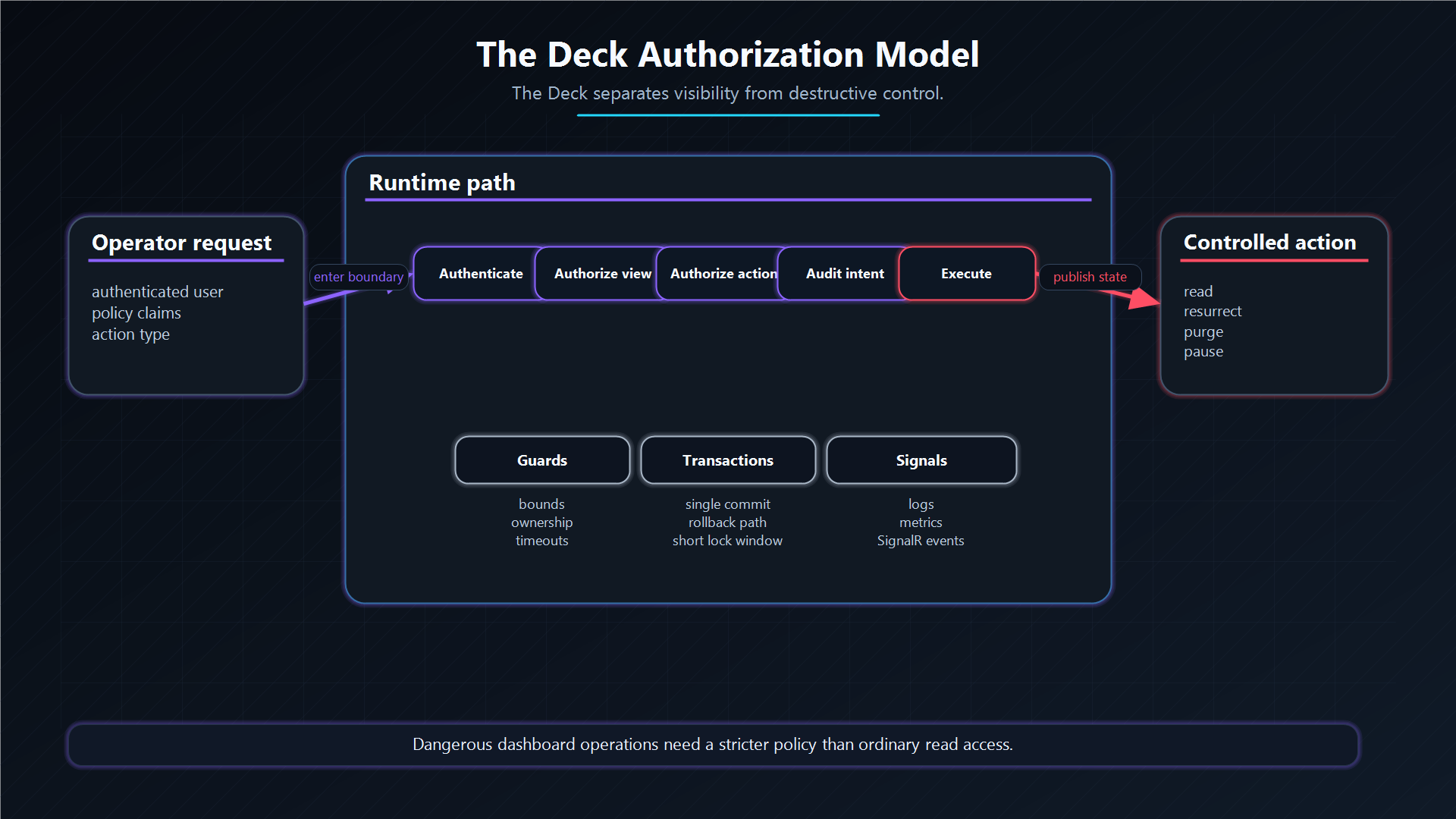
The Deck - administrative control plane. Он может inspect jobs, cancel work, edit payloads, requeue DLQ rows, purge data, pause queues и менять queue runtime controls. Он secure by default.
Options
| Option | Meaning |
|---|---|
AuthorizationPolicy | Read/connect policy для dashboard и hub. |
DestructiveAuthorizationPolicy | Более строгая policy для write/destructive hub commands. |
AllowAnonymousDeck | Explicit demo/sandbox escape hatch. Default is false. |
Если AuthorizationPolicy не задан, The Deck использует default authorization boundary host application. Если AllowAnonymousDeck true, policies нельзя одновременно configure'ить.
Endpoint protection
MapChokaQTheDeck() maps:
- static assets;
- SignalR hub at
{RoutePrefix}/hub; - dashboard Razor components at
{RoutePrefix}.
Если anonymous access не включен явно, hub и dashboard требуют authorization.
Destructive policy
Hub проверяет DestructiveAuthorizationPolicy на уровне methods для operations, которые mutate jobs или queues. Это позволяет read-only operators inspect'ить system без purge/edit/requeue privileges.
Архитектурное решение
Почему этот pattern?
Dashboard read access и destructive command access - разные privileges. Production systems часто требуют, чтобы больше людей могло observe, чем mutate.
Trade-offs
Две policies добавляют configuration burden. Выигрыш - чистое разделение incident visibility и destructive authority.
Рассмотренные альтернативы
| Alternative | Benefit | Cost |
|---|---|---|
| Anonymous by default | Easy demos. | Unsafe for production. |
| One policy for everything | Просто. | Нет read-only operator role. |
| App-specific auth inside every component | Flexible. | Repeated и error-prone. |
Дополнительные вопросы
Почему The Deck secure by default?
Потому что это write-capable operations console.
Зачем отдельная destructive policy?
Потому что inspect и mutate - разные operational privileges.
Когда anonymous access приемлем?
Только для local demos или intentionally public sandboxes.