
Edit + Resurrect (DLQ Management)
Проблема: dead jobs с исправимыми ошибками
Job падает из-за malformed JSON payload:
{
  "to": "user@example.com",
  "subject": "Welcome!"
  "body": "Hello, World!"     // ← Missing comma after "subject"
}
Без operator workflow команды часто уходят в manual recovery:
- fix code или data, затем manually enqueue replacement work;
- написать ad hoc SQL script для update failed row;
- оставить failed work unresolved, пока support process не обработает ее.
Эти paths могут быть valid в emergencies, но их сложно audit'ить и легко применять inconsistent.
Решение ChokaQ: Edit + Resurrect
The Deck дает in-browser editing DLQ job data и one-click resurrection.
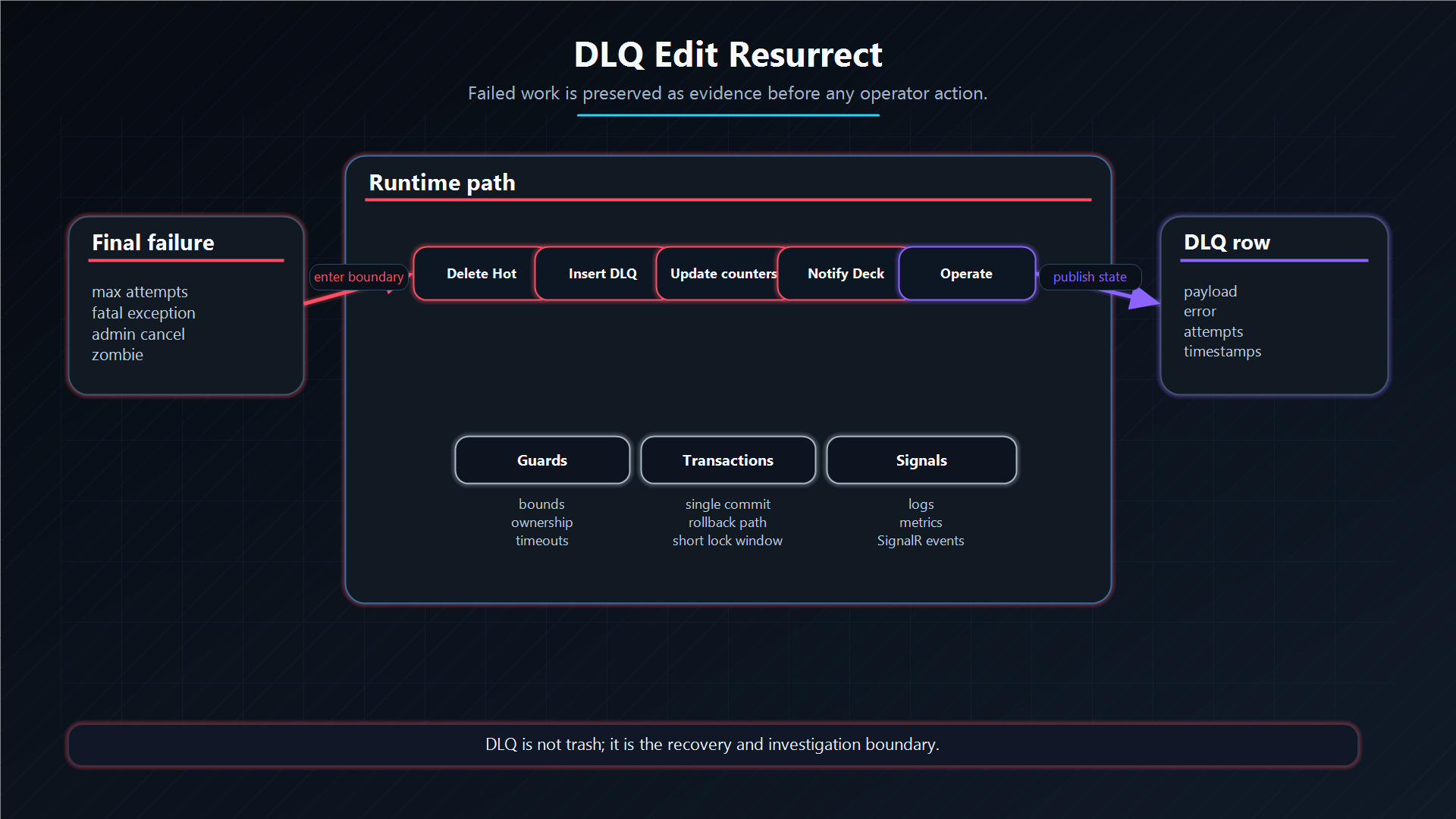
Workflow
1. Job fails → lands in DLQ with FailureReason + ErrorDetails
2. Admin opens The Deck → navigates to DLQ panel
3. Clicks on the failed job → Inspector opens
4. Sees the full exception stack trace
5. Edits the JSON payload directly in the browser
6. Clicks "Resurrect" → job moves back to JobsHot with fixed payload
7. Job processes successfully on the next fetch cycle
DLQ Inspector
Inspector panel показывает complete job details:
| Field | Example |
|---|---|
| Job ID | 01JARX7K8F... |
| Type | email_v1 |
| Queue | notifications |
| Failure Reason | MaxRetriesExceeded |
| Attempts | 3 |
| Failed At | 2026-04-30 14:32:07 UTC |
| Worker ID | worker-prod-01 |
| Error Details | Full exception with stack trace |
| Payload | Editable JSON |
| Tags | Editable metadata |
Editing dead jobs
Два уровня editing:
1. Edit in DLQ без resurrection
Fix data для later analysis или batch resurrection:
await _storage.UpdateDLQJobDataAsync(
    jobId: "job-123",
    updates: new JobDataUpdateDto
    {
        Payload = fixedJson,
        Tags = "reviewed,fixed-payload"
    },
    modifiedBy: "admin@company.com"
);
Job остается в DLQ, но уже с corrected data.
2. Edit + Resurrect: fix and retry
Fix payload AND move back to Hot table одной operation:
await _storage.ResurrectAsync(
    jobId: "job-123",
    updates: new JobDataUpdateDto
    {
        Payload = fixedJson,          // Fixed JSON
        Tags = "resurrected,manual",  // Audit trail
        Priority = 30                 // Boost priority
    },
    resurrectedBy: "admin@company.com"
);
Что происходит при resurrection
SQL atomically:
- Deletes job из
JobsDLQ. - Inserts into
JobsHotwith:Status = 0 (Pending)- back in queue;AttemptCount = 0- fresh start;- Updated Payload/Tags/Priority, если provided;
LastModifiedBy = "admin@company.com"- audit trail.
- Decrements
StatsSummary.FailedTotal- stats stay accurate.
DELETE FROM [chokaq].[JobsDLQ]
OUTPUT
    DELETED.[Id], DELETED.[Queue], DELETED.[Type],
    CASE WHEN @NewPayload IS NOT NULL
         THEN @NewPayload ELSE DELETED.[Payload] END,
    CASE WHEN @NewTags IS NOT NULL
         THEN @NewTags ELSE DELETED.[Tags] END,
    NULL,                              -- IdempotencyKey cleared
    ISNULL(@NewPriority, 10),          -- New or default priority
    0,                                 -- Status = Pending
    0,                                 -- AttemptCount = 0 (fresh)
    NULL, NULL,                        -- WorkerId, HeartbeatUtc
    NULL, DELETED.[CreatedAtUtc], NULL,
    SYSUTCDATETIME(),
    DELETED.[CreatedBy], @ResurrectedBy
INTO [chokaq].[JobsHot](...)
WHERE [Id] = @JobId;
Bulk operations
Bulk Resurrect
Resurrect multiple jobs at once, например "retry all zombies from yesterday":
var zombieIds = dlqJobs
    .Where(j => j.FailureReason == FailureReason.Zombie)
    .Select(j => j.Id)
    .ToArray();

int resurrected = await _storage.ResurrectBatchAsync(
    jobIds: zombieIds,
    resurrectedBy: "admin@company.com"
);
// Processed in batches of 1000 for transaction safety
Bulk Cancel
Cancel pending jobs, которые больше не нужны:
int cancelled = await _storage.ArchiveCancelledBatchAsync(
    jobIds: selectedIds,
    cancelledBy: "admin@company.com"
);
Purge
Permanently delete jobs from DLQ, irreversible:
await _storage.PurgeDLQAsync(jobIds);Или purge old archive entries:
int deleted = await _storage.PurgeArchiveAsync(
    olderThan: DateTime.UtcNow.AddDays(-90)
);
SQL Server cleanup удаляет rows bounded transactions под контролем SqlServer.CleanupBatchSize (default: 1000). Operators все равно вызывают один purge method, но storage под ним повторяет short database commits, чтобы retention work не monopolize locks или transaction log space.
Safety gates
Hot-edit safety
Editing active jobs в Hot table restricted:
// UpdateJobDataAsync — only works for Pending jobs
public async ValueTask<bool> UpdateJobDataAsync(
    string jobId, JobDataUpdateDto updates, ...)
{
    // WHERE Status = 0 — Safety gate!
    // Cannot edit Fetched or Processing jobs
}
Если job уже processing (Status = 1 or 2), edit возвращает false. Это предотвращает corruption in-flight work.
DLQ edit safety
DLQ edits не имеют status restriction: job уже dead. Но все edits audited через LastModifiedBy.
💡 Design Decision
Когда job resurrected, его AttemptCount reset'ится в 0, потому что root cause, вероятно, исправлена: payload corrected, external service restored. Это дает job полный fresh retry budget. Если fix не сработал, Smart Worker classify error и отправит job обратно в DLQ.
Common use cases
| Scenario | Action |
|---|---|
| Malformed JSON payload | Edit payload in DLQ -> Resurrect |
| External API was down | Wait for recovery -> Bulk resurrect all MaxRetriesExceeded |
| Code bug fixed and deployed | Bulk resurrect all Fatal jobs of that type |
| Zombie from server restart | Resurrect if idempotent, Purge if not |
| Cancelled by mistake | Resurrect with original data |
| Old archive cleanup | PurgeArchiveAsync(olderThan: 90 days) |
Архитектурное решение
Edit and resurrect существует потому, что production failures не всегда исправляются restart workers. Иногда handler correct, а payload wrong; иногда dependency outage завершился, и dead work нужен controlled second chance. Заставлять operators писать ad hoc SQL для такого workflow рискованно и плохо audit'ится.
ChokaQ делает resurrection first-class storage operation. Он move'ит DLQ row обратно в Hot одной database operation, reset'ит retry state, records who made the change и дает normal worker path обработать job снова. Так recovery остается в той же lifecycle model, а не создает parallel manual re-enqueue path.
Trade-off - power. Editing payloads - опасная capability, и она должна быть protected authorization, audit logging и operational discipline. The Deck должен делать workflow easy, но не casual.
Дополнительные вопросы
Почему reset AttemptCount during resurrection?
Resurrection подразумевает, что operator изменил conditions: payload fixed, code deployed или dependency recovered. Fresh retry budget дает normal policy оценить repaired job.
Почему не update DLQ row in place и process it from DLQ?
Потому что DLQ - terminal inspection table. Move row back to Hot восстанавливает standard execution path: fetch, processing, heartbeat, retry, archive и metrics.
Что предотвращает unsafe editing of in-flight jobs?
Hot edits ограничены Pending jobs. Fetched и Processing jobs принадлежат workers, поэтому editing corrupt'ил бы active execution.
Фаза The Deck завершена. Для начала см. Быстрый старт или Architecture.