
Bus Vs Pipe Dispatch
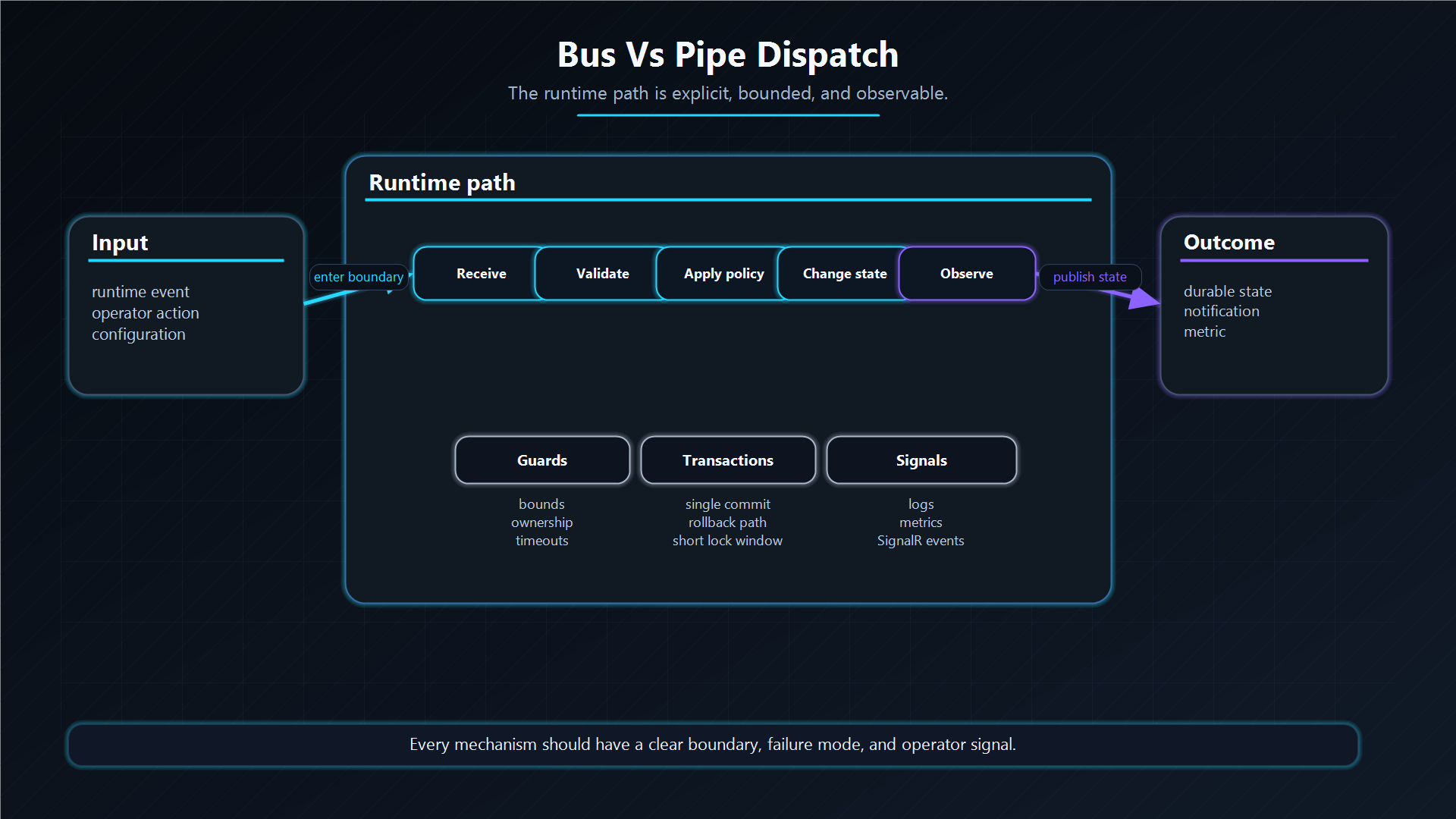
ChokaQ has two dispatch modes.
| Mode | Best for | Handler shape |
|---|---|---|
| Bus | Typed domain jobs. | IChokaQJobHandler<TJob> |
| Pipe | Raw event-style payloads. | IChokaQPipeHandler |
Bus mode is the default choice for application workflows. Pipe mode is a lower level path when a host wants one handler to receive many job types as raw payloads.
Bus Mode
Bus mode flow:
- Persisted type key resolves to a CLR job type.
- Payload deserializes into the job DTO.
- DI resolves
IChokaQJobHandler<TJob>. - A compiled expression delegate invokes
HandleAsync. - Middleware wraps the handler.
Bus mode gives strong typing, normal DI, and compile-time handler contracts.
Pipe Mode
Pipe mode flow:
- The worker reads the persisted job type string.
- Payload remains raw.
- DI resolves one
IChokaQPipeHandler. - Middleware wraps the pipe handler.
- The handler receives
(jobType, payload, cancellationToken).
Pipe mode fits high-throughput routing, integration events, or hosts that own their own payload parsing.
Shared Runtime Policy
Both modes share:
- durable storage;
- worker fetch;
- circuit breaker check;
- retry/DLQ policy;
- heartbeat;
- metrics;
- The Deck visibility;
- middleware pipeline.
Only dispatch shape changes.
Architecture Decision
Why this pattern?
The product needs ergonomic typed handlers for normal users and a raw dispatch path for advanced/high-throughput scenarios. Keeping both modes behind one processor lets reliability policy stay consistent.
Trade-offs
Two modes increase documentation and testing surface. The benefit is that ChokaQ can serve both domain-command workflows and raw event processing without forking the runtime.
Alternatives considered
| Alternative | Benefit | Cost |
|---|---|---|
| Bus only | Simpler mental model. | Less flexible for raw event streams. |
| Pipe only | Minimal dispatch model. | Loses typed handler ergonomics. |
| Separate products | Strong isolation. | Duplicated runtime policy. |
Additional Questions
Which mode should most apps start with?
Bus mode, because typed contracts and handlers are easier to reason about.
Why keep Pipe mode?
It supports raw payload processing without forcing every event into a typed handler registration.
Do reliability guarantees differ by mode?
No. Storage, retries, DLQ, heartbeat, and circuit breakers are shared.