
SQL Query Reference
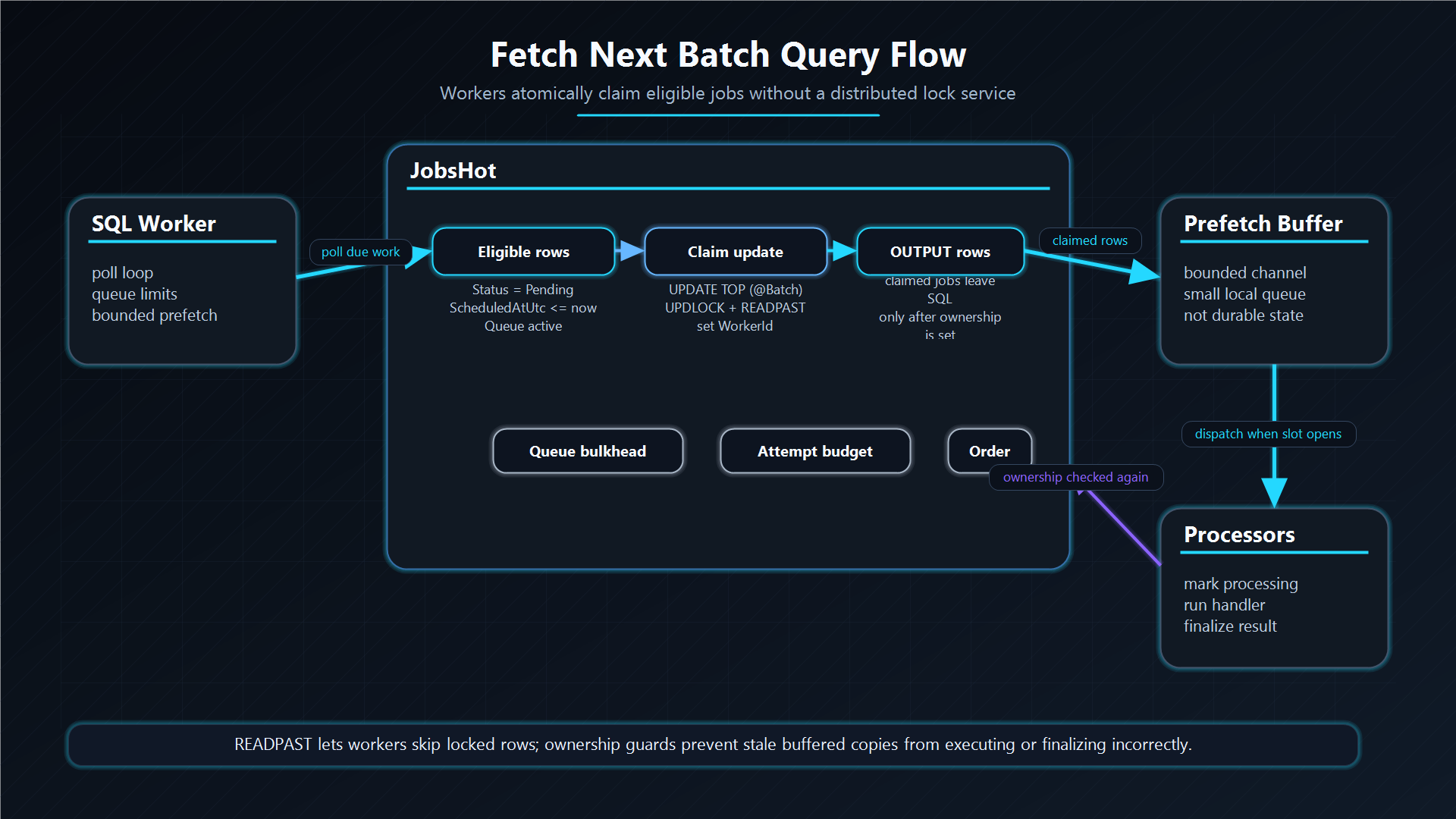
This page explains the runtime intent behind the important SQL operations. It is not a replacement for Queries.cs; it is the architectural reading guide for the query set.
Fetch Next Batch
Caller: SqlJobStorage.FetchNextBatchAsync from SqlJobWorker.FetcherLoopAsync.
Intent: claim eligible pending rows from JobsHot without blocking other workers and without exceeding per-queue worker budgets.
Tables touched:
JobsHotQueues
Key behavior:
ActiveCountscounts fetched/processing rows per queue.Candidatesfinds pending rows that are due and not paused.ROW_NUMBER()ranks candidates inside each queue.UPDLOCK, READPASTlets workers skip rows already being claimed.UPDATE ... OUTPUT inserted.*claims rows and returns the claimed data.
Failure mode: if no rows are eligible, the worker sleeps for PollingInterval. If the SQL call fails transiently, the storage retry policy can retry the operation.
Mark As Processing
Caller: JobProcessor through IJobStateManager.
Intent: convert a fetched row into an execution lease right before user code runs.
Tables touched:
JobsHot
Key behavior:
- Sets
Status = Processing. - Increments
AttemptCount. - Sets
StartedAtUtc. - Initializes
HeartbeatUtc. - Requires matching
WorkerIdandFetchedstatus when worker ownership is supplied.
This is the final stale-prefetch guard. If the row was released, reclaimed, or changed after fetch, the update affects zero rows and user code is not executed.
Keep Alive
Caller: job heartbeat loop during processing.
Intent: update HeartbeatUtc so zombie rescue knows the job is still alive.
Tables touched:
JobsHot
Failure mode: repeated heartbeat write failures are logged and counted. Based on configuration, execution may continue or be cancelled after a threshold.
Archive Succeeded
Caller: JobProcessor after successful handler completion.
Intent: atomically move a completed job from active work to history.
Tables touched:
JobsHotJobsArchiveStatsSummaryMetricBuckets
Key behavior:
- Starts a short transaction with
XACT_ABORT ON. - Deletes the exact row from
JobsHot. - Captures deleted data into a table variable via
OUTPUT. - Inserts captured data into
JobsArchive. - Updates lifetime counters.
- Updates rolling metric buckets.
- Commits only if the whole move succeeds.
Reschedule For Retry
Caller: JobStateManager after retryable failure or open circuit.
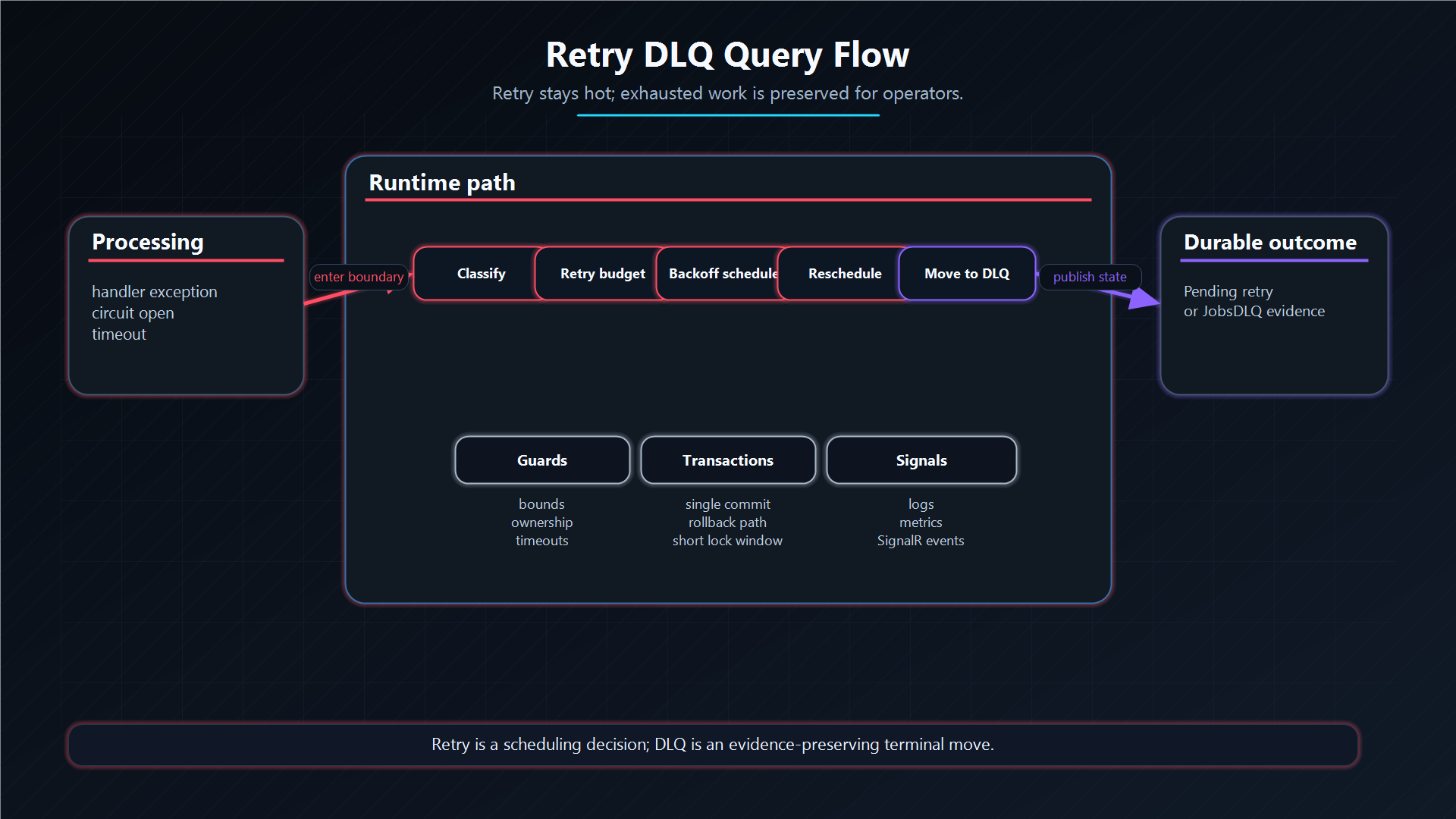
Intent: keep the job in JobsHot, set it back to pending, and schedule it for a future retry.
Tables touched:
JobsHotStatsSummary
Key behavior:
- Status becomes pending.
- Worker ownership is cleared.
ScheduledAtUtcis set to the calculated retry time.- Retry counters are updated for operator visibility.
Move To DLQ
Caller: failure finalization, cancellation, zombie rescue, and admin paths.
Intent: atomically remove a job from active execution and preserve it for operator inspection.
Tables touched:
JobsHotJobsDLQStatsSummaryMetricBuckets
The pattern mirrors Archive: delete from Hot, capture deleted row, insert into DLQ, update counters and metric buckets in the same transaction.
Resurrect
Caller: The Deck or storage API.
Intent: atomically move a DLQ job back into active work.
Tables touched:
JobsDLQJobsHotStatsSummary
Key behavior:
- Deletes from
JobsDLQfirst. - Inserts into
JobsHotwith status pending and attempt count reset. - Optionally applies edited payload/tags/priority.
- Rolls back the DLQ delete if the Hot insert fails.
Recover Abandoned
Caller: ZombieRescueService.
Intent: release fetched rows that never reached processing.
Tables touched:
JobsHot
Fetched rows have not executed user code. If they sit too long, the system can safely reset them to pending by clearing WorkerId and setting Status = 0.
Archive Zombies
Caller: ZombieRescueService.
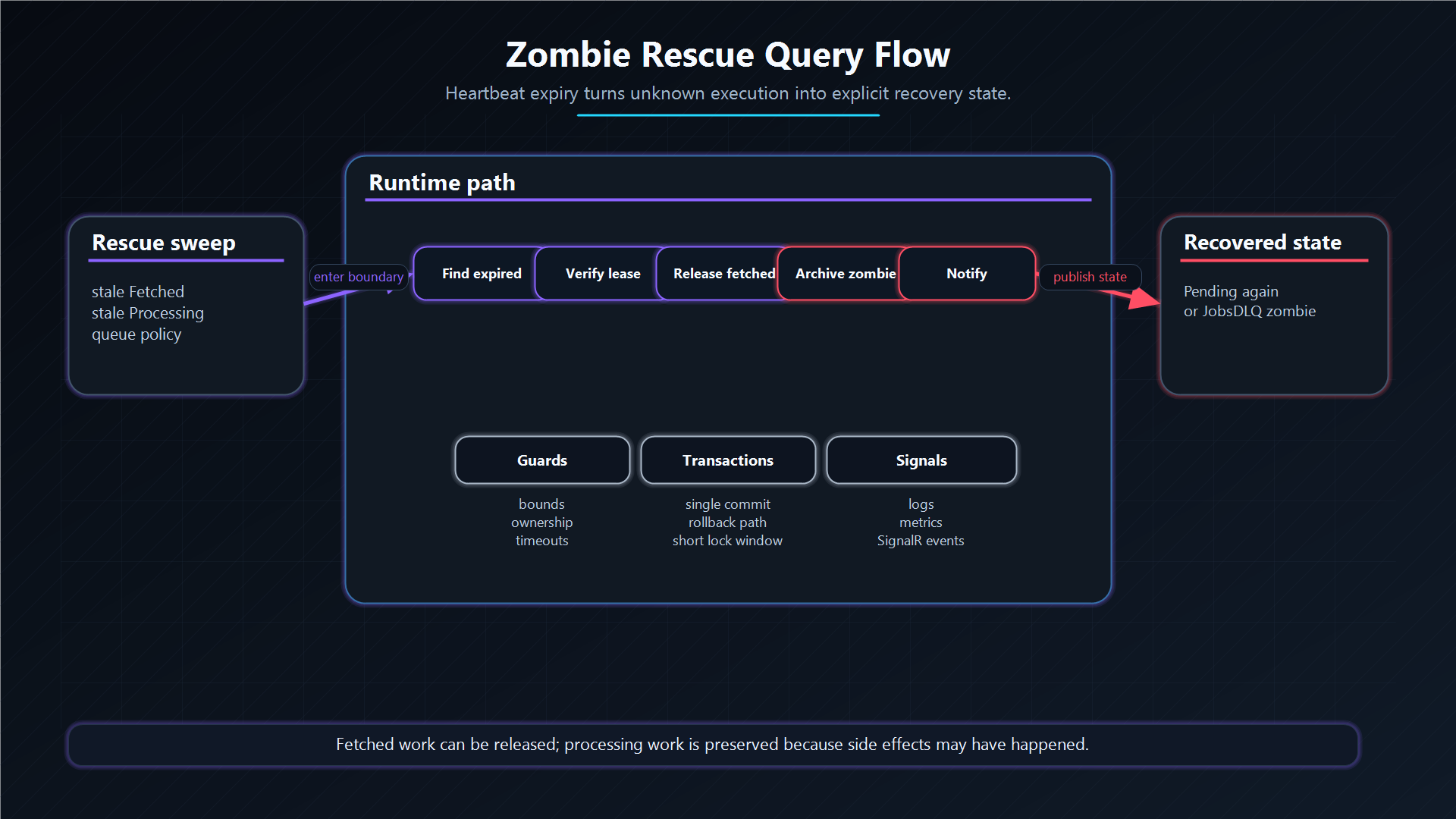
Intent: move processing rows with expired heartbeat to DLQ.
Tables touched:
JobsHotJobsDLQStatsSummaryMetricBucketsQueues
Processing zombies are not automatically retried because user code may have already produced side effects.
Dashboard Reads
Dashboard queries use bounded, purpose-specific reads:
| Query | Purpose |
|---|---|
GetSummaryStats | Global lifetime counts. |
GetQueueStats | Per-queue status counts and totals. |
GetQueueHealth | Queue lag and pending saturation. |
GetThroughputStats | Recent rate from MetricBuckets. |
GetTopDlqErrors | Bounded recent DLQ error grouping. |
GetArchivePaged | Committed archive page. |
GetDLQPaged | Committed DLQ page. |
Telemetry reads may use approximate committed snapshots where exactness is not part of the safety contract. State transitions do not rely on those snapshots.
Architecture Decision
Why this pattern?
The database is the coordination boundary. Workers do not coordinate through process memory or distributed locks; they claim rows through SQL state changes.
Trade-offs
SQL coordination is transparent and durable, but the database becomes a central performance boundary. Index design, short transactions, and bounded dashboard queries are therefore part of the runtime contract.
Alternatives considered
| Alternative | Benefit | Cost |
|---|---|---|
| Distributed lock service | Explicit lease control. | Extra infrastructure and another failure mode. |
| Broker visibility timeout | Proven queue primitive. | Less direct SQL inspection and different operational model. |
| App-level copy/delete | Easy to write. | Unsafe cross-table moves under crash/failure. |
Additional Questions
Why use UPDATE ... OUTPUT for fetch?
Because claiming and returning the exact claimed rows must be one operation.
What protects against stale prefetched work?MarkAsProcessing validates worker ownership immediately before dispatch.
Are dashboard NOLOCK reads used for correctness?
No. They are for observational views only. Correctness comes from state transition predicates and transactions.