
CHK-04: Expression Trees For Dispatch
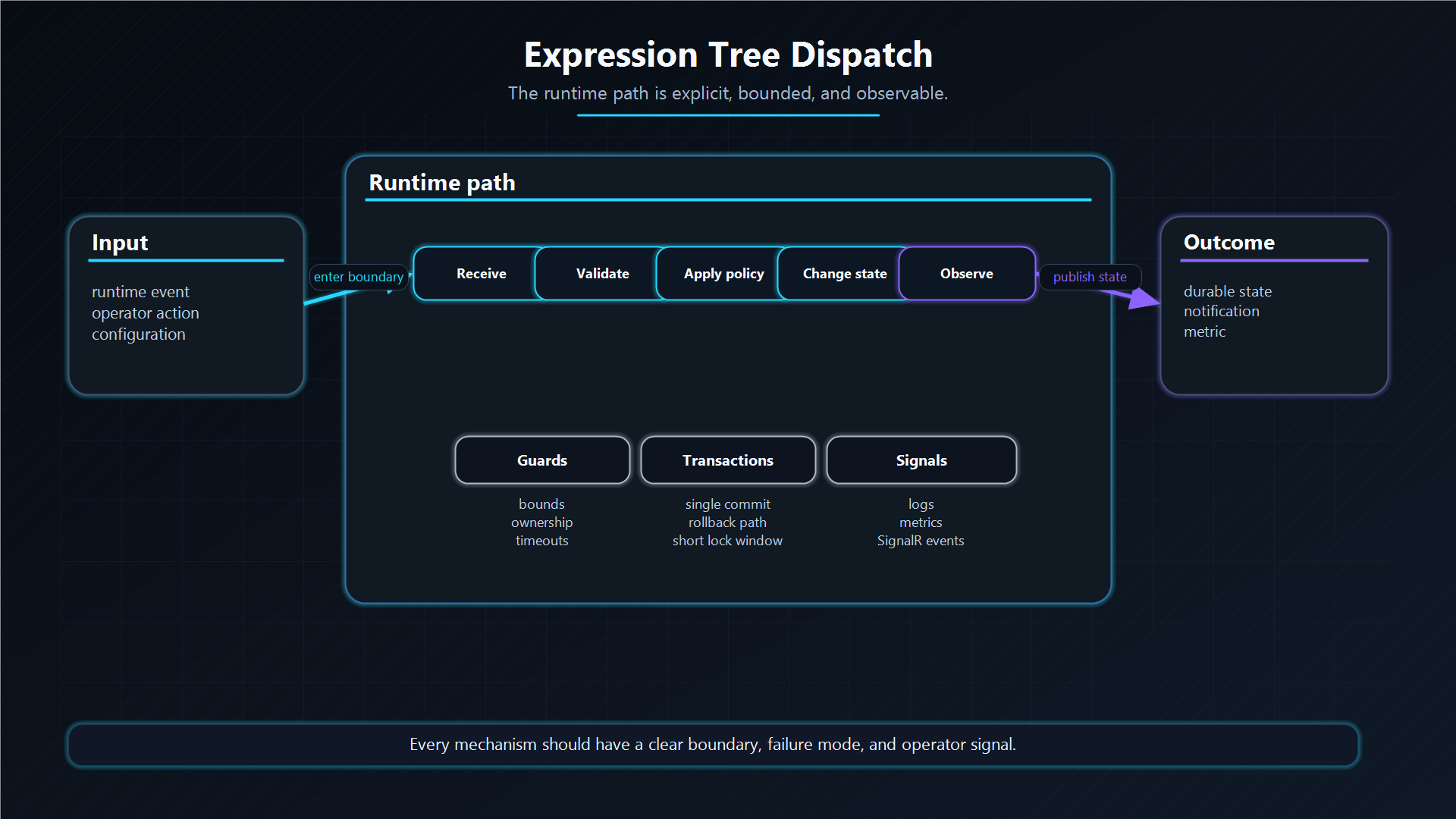
The Problem: Runtime Type Dispatch
When a runtime uses the IJobHandler<TJob> pattern, it needs to:
- Determine the handler type from the job type
- Resolve the handler from DI
- Invoke
HandleAsync(job, ct)on the handler
Step 3 needs care. The handler and job types are known only at runtime, so the dispatcher works with object, not IChokaQJobHandler<SendEmailJob>. A direct reflection invocation is simple to implement:
// Reflection-based dispatch
var method = handlerType.GetMethod("HandleAsync");
await (Task)method.Invoke(handler, new object[] { job, ct });
MethodInfo.Invoke adds overhead on every execution. For a job engine, handler dispatch is on the hot path, so ChokaQ pays the dynamic-binding cost once and then reuses a compiled delegate.
The Solution: Compiled Expression Trees
ChokaQ compiles a strongly-typed delegate from an Expression Tree once, caches it, and reuses it for every subsequent call:
// From: ChokaQ.Core/Execution/BusJobDispatcher.cs

private Func<object, IChokaQJob, CancellationToken, Task> CreateDelegate(
    Type handlerType, Type jobType)
{
    // Parameters: (object handler, IChokaQJob job, CancellationToken ct)
    var handlerParam = Expression.Parameter(typeof(object), "handler");
    var jobParam = Expression.Parameter(typeof(IChokaQJob), "job");
    var ctParam = Expression.Parameter(typeof(CancellationToken), "ct");

    // Cast: (IChokaQJobHandler<TJob>)handler
    var castedHandler = Expression.Convert(handlerParam, handlerType);

    // Cast: (TJob)job
    var castedJob = Expression.Convert(jobParam, jobType);

    // Find the method: HandleAsync(TJob, CancellationToken)
    var handleMethod = handlerType.GetMethod("HandleAsync",
        new[] { jobType, typeof(CancellationToken) })!;

    // Build the call: ((THandler)handler).HandleAsync((TJob)job, ct)
    var callExpr = Expression.Call(castedHandler, handleMethod, castedJob, ctParam);

    // Compile into a reusable delegate
    var lambda = Expression.Lambda<Func<object, IChokaQJob, CancellationToken, Task>>(
        callExpr, handlerParam, jobParam, ctParam);

    return lambda.Compile();
}
What the Compiled Delegate Looks Like
The Expression Tree above generates the equivalent of this C# code:
// What the JIT actually executes (conceptual):
(object handler, IChokaQJob job, CancellationToken ct) =>
    ((IChokaQJobHandler<SendEmailJob>)handler)
        .HandleAsync((SendEmailJob)job, ct);
This call path avoids MethodInfo.Invoke on repeated executions and keeps the dynamic work outside the per-job hot path.
The Caching Layer
Delegates are cached in a ConcurrentDictionary keyed by job type string:
private readonly ConcurrentDictionary<string, Func<object, IChokaQJob, CancellationToken, Task>>
    _delegateCache = new();

public async Task DispatchAsync(JobHotEntity job, CancellationToken ct)
{
    // 1. Resolve job type from registry
    var jobType = _registry.GetJobType(job.Type);

    // 2. Get or create the compiled delegate
    var invoker = _delegateCache.GetOrAdd(job.Type,
        _ => CreateDelegate(handlerType, jobType));

    // 3. Resolve handler from DI (scoped)
    var handler = scope.ServiceProvider.GetRequiredService(handlerInterfaceType);

    // 4. Deserialize through the shared ChokaQ serializer contract
    var jobInstance = _serializer.Deserialize(job.Payload, jobType);

    // 5. Invoke — this is now a DIRECT CALL, not reflection
    await invoker(handler, jobInstance, ct);
}
Performance characteristics:
| Operation | First Call | Every Subsequent Call |
|---|---|---|
Find method (GetMethod) | ✅ Once | ❌ Skipped |
| Build expression tree | ✅ Once | ❌ Skipped |
| Compile to delegate | ✅ Once (~1ms) | ❌ Skipped |
| Execute delegate | ✅ Direct call | ✅ Direct call |
After the first invocation, every call uses the cached delegate instead of rebuilding the dispatch path.
Step-by-Step: Building the Expression Tree
Let's walk through exactly what happens for a SendEmailJob + EmailHandler:
Step 1: Define Parameters
var handlerParam = Expression.Parameter(typeof(object), "handler");
var jobParam = Expression.Parameter(typeof(IChokaQJob), "job");
var ctParam = Expression.Parameter(typeof(CancellationToken), "ct");
These are the lambda's input parameters. We use object and IChokaQJob as the base types to create a generic delegate signature.
Step 2: Cast to Concrete Types
var castedHandler = Expression.Convert(handlerParam,
    typeof(IChokaQJobHandler<SendEmailJob>));
    // Generates: (IChokaQJobHandler<SendEmailJob>)handler

var castedJob = Expression.Convert(jobParam, typeof(SendEmailJob));
    // Generates: (SendEmailJob)job
Step 3: Build the Method Call
var handleMethod = typeof(IChokaQJobHandler<SendEmailJob>)
    .GetMethod("HandleAsync");

var callExpr = Expression.Call(
    castedHandler, handleMethod, castedJob, ctParam);
    // Generates: ((IChokaQJobHandler<SendEmailJob>)handler)
    //                .HandleAsync((SendEmailJob)job, ct)
Step 4: Wrap in Lambda and Compile
var lambda = Expression.Lambda<
    Func<object, IChokaQJob, CancellationToken, Task>>(
    callExpr, handlerParam, jobParam, ctParam);

return lambda.Compile();
// Returns: a delegate that can be called like a normal method
Alternatives
| Approach | Speed | Complexity | Trade-off |
|---|---|---|---|
MethodInfo.Invoke | Slower | Low | Simple, but pays invocation overhead on every job. |
DynamicMethod + IL Emit | Very fast | Very High | Powerful, but harder to maintain and review. |
| Expression Trees | Near direct-call | Medium | Good balance of speed, clarity, and runtime flexibility. |
| Source Generators | Compile-time dispatch | High | Strong option when all job types are known at compile time. |
💡 Architecture Insight
This pattern is widely used in high-performance .NET libraries. EF Core uses Expression Trees for LINQ-to-SQL translation. ASP.NET Core uses them for model binding and request delegate compilation. AutoMapper uses them for property mapping. ChokaQ applies this same technique specifically to bypass the DI → Handler invocation bottleneck.
Architecture Decision
ChokaQ uses compiled expression trees because job type and handler type are known only after the runtime resolves the serialized job type key. The runtime therefore needs dynamic dispatch, but it should not pay reflection invocation cost for every job.
Expression trees give a middle ground: the first execution for a job type builds and compiles a strongly typed delegate; later executions reuse that delegate. The resulting call path is close to normal generic code while keeping the runtime flexible enough to dispatch jobs discovered through the registry.
The main trade-off is startup cost for the first job of each type and a small cache surface. That is acceptable because the cost is paid once per job type, not once per job execution.
Additional Questions
Why is reflection lookup acceptable but MethodInfo.Invoke is not?
Reflection lookup happens during delegate creation and is cached. Invoke would run for every job and would keep the hot execution path slow.
Why not use source generators?
Source generators can be faster, but they require a more complex compile-time pipeline and make dynamic registration harder. Expression trees keep the runtime package simpler while removing the per-job reflection cost.
What is the failure mode if a handler signature is wrong?
Delegate creation fails early for that job type. That gives an explicit startup or first-use failure instead of accepting a handler that cannot execute the registered payload.
Who Else Uses This Pattern?
| Framework | What It Compiles |
|---|---|
| EF Core | LINQ expressions → SQL queries |
| ASP.NET Core | Route handlers → request delegates |
| AutoMapper | Property mapping rules → copy delegates |
| MediatR | Handler resolution → dispatch delegates |
| ChokaQ | Job handler invocation → cached delegates |
Next: See how the Dynamic Concurrency Limiter enables runtime concurrency scaling without restarts.