
Deduplication Layer
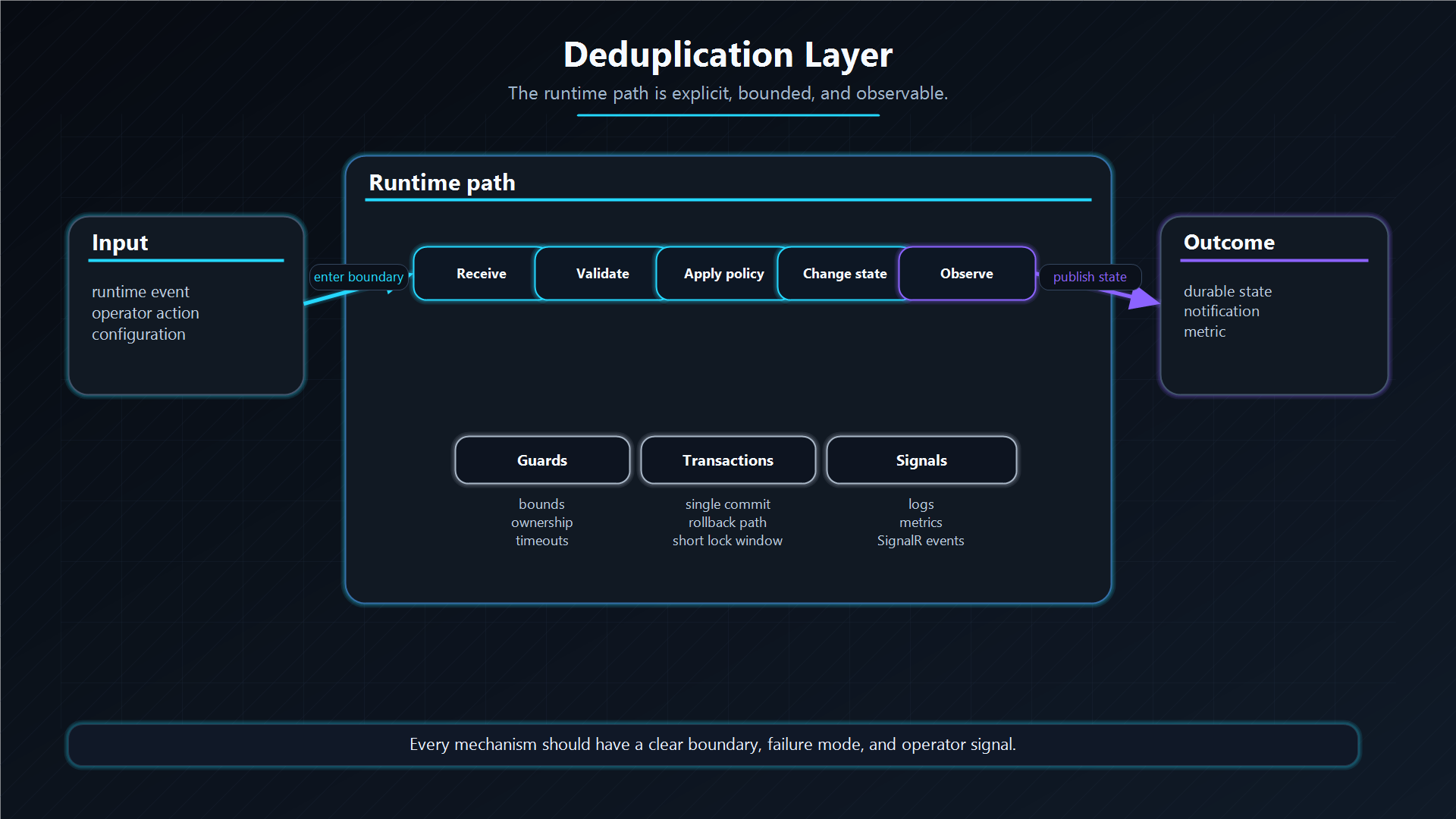
The deduplication layer is a lightweight active-key guard. It is separate from durable enqueue idempotency and from handler idempotency middleware.
Its role is to suppress short-lived duplicate actions such as double-clicks, retry storms, or repeated local attempts before they hit a heavier boundary.
Where It Lives
| Runtime type | Role |
|---|---|
IDeduplicator | Internal contract for time-limited key acquisition. |
InMemoryDeduplicator | Process-local implementation using ConcurrentDictionary and timer cleanup. |
Behavior
TryAcquireAsync(key, ttl) returns:
truewhen the key is new or expired;falsewhen the key is already active.
Expired keys are removed by a background cleanup timer.
Correctness Boundary
The in-memory deduplicator is process-local. It does not provide durable or cross-host exactly-once behavior. Do not use it as a substitute for SQL idempotency keys or handler idempotency.
Architecture Decision
Why this pattern?
Some duplicate suppression is useful before reaching storage or expensive runtime paths. A small in-memory guard is enough for local burst suppression without adding infrastructure.
Trade-offs
Process-local deduplication does not work across multiple hosts and disappears on restart. That is acceptable only for soft suppression, not correctness.
Alternatives considered
| Alternative | Benefit | Cost |
|---|---|---|
| Durable SQL dedupe for everything | Stronger. | More database writes for soft duplicate suppression. |
| Distributed cache lock | Cross-host. | Extra infrastructure and failure modes. |
| No dedupe layer | Simpler. | More repeated local work under bursts. |
Additional Questions
Is this exactly-once protection?
No. It is a soft process-local duplicate guard.
What should protect business side effects?
Handler idempotency and downstream/provider idempotency.
Why have this layer at all?
To cheaply reduce repeated local actions before they become heavier storage or execution work.