
Retry And DLQ Lifecycle
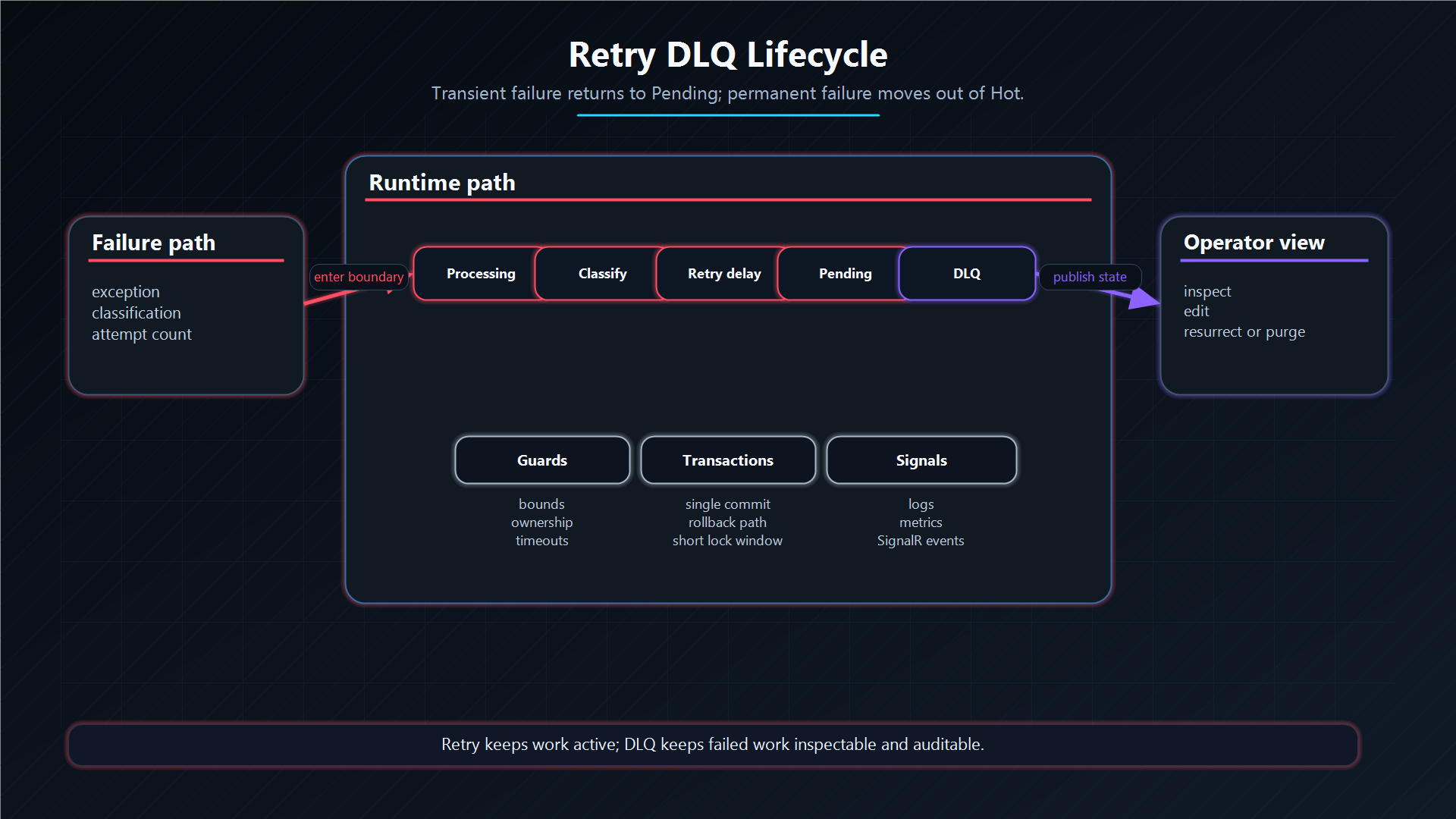
Retries and DLQ are separate decisions.
A retry says: "This job may succeed later."
DLQ says: "Automatic execution should stop; a human or a repair workflow must inspect this job."
ChokaQ keeps that distinction explicit so transient outages do not become operator noise, and permanent failures do not burn worker capacity forever.
Normal Retry Path
- A worker moves the job from
FetchedtoProcessing. - The handler throws an exception.
- The processor classifies the failure.
- If the failure is retryable and the retry budget remains, ChokaQ calculates a future
ScheduledAtUtc. - The row remains in
JobsHot. - Workers skip the row until it becomes due.
- The next execution increments
AttemptCountwhen it crosses intoProcessing.
Retry scheduling is stored in SQL. No sleeping thread owns the delay.
DLQ Path
A job moves to JobsDLQ when automatic processing is no longer the right decision. Common reasons include:
| Reason | Meaning | Operator action |
|---|---|---|
MaxRetriesExceeded | Retry budget was exhausted. | Inspect error, fix dependency or payload, then resurrect if safe. |
FatalError | The failure was classified as non-transient. | Fix code/data before retrying. |
Cancelled | An operator or runtime path cancelled the job. | Confirm cancellation was intentional. |
Zombie | Processing heartbeat expired. | Check side effects before resurrection. |
CircuitBreakerOpen | The runtime refused execution because the circuit was open. | Fix downstream or wait for recovery. |
Throttled | Downstream asked the system to slow down. | Respect retry-after or tune traffic. |
RetryLifetimeExpired | Job age exceeded policy. | Treat as stale work. |
DLQ is not just an error table. It is the operational queue for work that needs judgment.
Retry Delay Inputs
Retry delay uses policy from ChokaQ:Retry:
| Setting | Purpose |
|---|---|
MaxAttempts | Bounds how many executions can start. |
BaseDelay | Initial delay after a transient failure. |
BackoffMultiplier | Exponential growth factor. |
MaxDelay | Hard cap for retry delay. |
JitterMaxDelay | Random spread to avoid synchronized retry storms. |
CircuitBreakerDelay | Delay when execution is blocked by an open breaker. |
MaxJobAge | Prevents very old jobs from retrying forever. |
Why DLQ Exists
Without DLQ, a queue engine has two bad options:
- keep retrying bad work forever;
- drop bad work silently.
ChokaQ chooses a third option: preserve the failed job with its payload, failure reason, error details, attempt count, queue, type key, and timestamps. The operator can then inspect, edit, resurrect, purge, or leave it for audit.
Architecture Decision
Why this pattern?
At-least-once systems need a durable terminal state for work that automatic execution cannot safely complete. DLQ provides that terminal state without destroying evidence.
Trade-offs
DLQ creates an operational responsibility. Someone must monitor it and decide what to do. The benefit is explicit evidence and operator control instead of unbounded retry churn around the same poison message.
Alternatives considered
| Alternative | Benefit | Cost |
|---|---|---|
| Infinite retries | Simple to implement. | Retry storms, extra worker usage, hidden poison jobs. |
| Drop failed jobs | Keeps queues clean. | Loses accepted work and destroys audit evidence. |
| External error topic only | Works in broker systems. | Still needs storage, tooling, and operator workflow. |
When not to use this approach
For disposable telemetry events where loss is acceptable, a durable DLQ may be too heavy. For business workflows, payments, emails, reports, and integrations, DLQ is the safer default.
Additional Questions
Why not retry forever?
Because permanent failures become retry storms and consume capacity that healthy jobs need.
Why do zombies go to DLQ instead of retry?
Because the handler may have already produced side effects. Blind retry can duplicate emails, charges, or external writes.
What makes retry safe?
Only handler idempotency and downstream idempotency make external side effects safe. ChokaQ can preserve and reschedule work, but it cannot make arbitrary side effects exactly-once.