
CHK-03: Bulkhead Isolation
The Noisy Neighbor Problem
Imagine two queues in your system:
| Queue | Task | Duration | Volume |
|---|---|---|---|
pdf-generation | Generate 200-page reports | 30–120 seconds | 50/hour |
sms-notifications | Send SMS via API | 200ms | 10,000/hour |
Without isolation, a burst of PDF jobs can consume the available execution slots. SMS notifications then wait behind a workload with very different duration and urgency.
This is the Noisy Neighbor problem: one resource-intensive workload affects latency for unrelated work.
ChokaQ's Solution: Database-Level Bulkheads
ChokaQ solves this at the SQL query level — inside the FetchNextBatch CTE:
-- From: Queries.cs — FetchNextBatch

WITH ActiveCounts AS (
    -- Count committed active jobs per queue. This is part of capacity control,
    -- so it must not use dirty reads.
    SELECT [Queue], COUNT(1) AS CurrentActive
    FROM [chokaq].[JobsHot]
    WHERE [Status] IN (1, 2)    -- Fetched + Processing
    GROUP BY [Queue]
)
SELECT TOP (@Limit) h.*
FROM [chokaq].[JobsHot] h WITH (UPDLOCK, READPAST)
LEFT JOIN [chokaq].[Queues] q ON h.[Queue] = q.[Name]
LEFT JOIN ActiveCounts ac ON h.[Queue] = ac.[Queue]
WHERE h.[Status] = 0
  AND (q.[IsPaused] IS NULL OR q.[IsPaused] = 0)
  AND (q.[IsActive] IS NULL OR q.[IsActive] = 1)
  -- THE BULKHEAD: simple form shown for readability.
  -- Production SQL ranks candidates per queue and applies:
  -- CurrentActive + QueueRank <= MaxWorkers
  AND (q.[MaxWorkers] IS NULL OR ISNULL(ac.CurrentActive, 0) < q.[MaxWorkers])
  AND (h.[ScheduledAtUtc] IS NULL OR h.[ScheduledAtUtc] <= SYSUTCDATETIME())
ORDER BY h.[Priority] DESC,
         ISNULL(h.[ScheduledAtUtc], h.[CreatedAtUtc]) ASC
How It Works
The Queues table has a MaxWorkers column:
CREATE TABLE [chokaq].[Queues](
    [Name]                 VARCHAR(255) NOT NULL,
    [IsPaused]             BIT NOT NULL DEFAULT 0,
    [IsActive]             BIT NOT NULL DEFAULT 1,
    [ZombieTimeoutSeconds] INT NULL,
    [MaxWorkers]           INT NULL,    -- 👈 Bulkhead limit
    [LastUpdatedUtc]       DATETIME2(7) NOT NULL
);
Configuration example:
| Queue | MaxWorkers | Effect |
|---|---|---|
pdf-generation | 3 | Maximum 3 PDFs processing simultaneously |
sms-notifications | NULL | No limit — use all available capacity |
email-sending | 10 | Cap at 10 concurrent email sends |
The Visualization
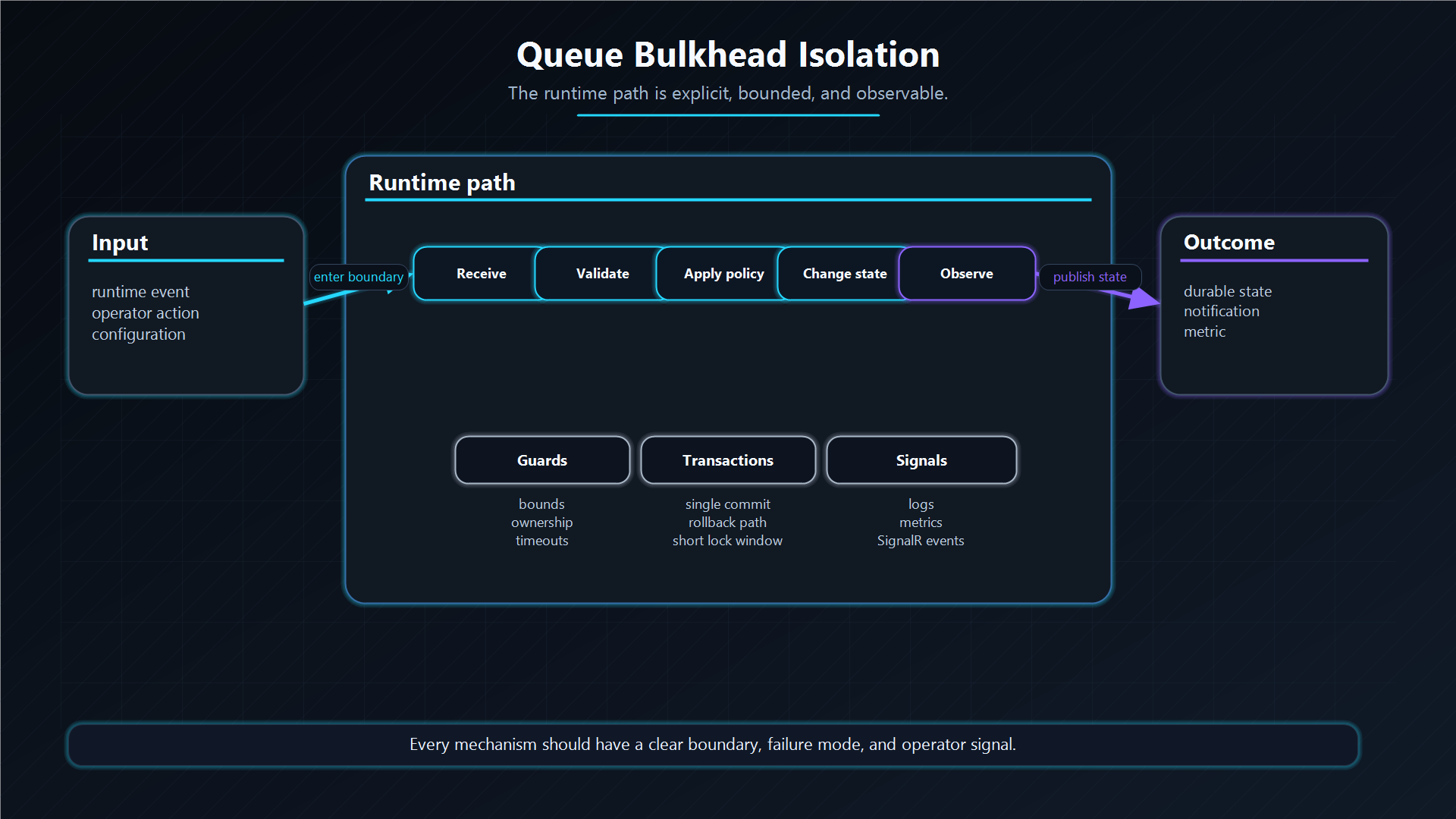
With the PDF queue capped at three active jobs, SMS work can still be claimed when worker capacity is available instead of waiting behind the entire PDF backlog.
Why Database-Level?
Bulkheads can be enforced in several places. Process-local semaphores are easy to reason about inside one host. ChokaQ enforces this limit in the storage claim path because the SQL database is shared by all worker instances:
| Approach | Trade-off |
|---|---|
| Process-local (thread pools or semaphores) | Simple inside one host, but each instance owns its own limit. |
| Database-level (ChokaQ) | Slightly more SQL work during fetch, but all instances see the same active counts. |
💡 Architecture Insight
Enforcing the Bulkhead pattern at the database level gives every worker the same committed view of active work. Production SQL also ranks candidates per queue, which prevents one fetch batch from claiming more rows than the queue's remaining capacity.
💡 The Scale Trade-off (Why Database-Level?)
You might ask: "Isn't running COUNT(1) on the database for every fetch expensive?" The cost depends on table shape. Because ChokaQ uses the Three Pillars architecture, JobsHot only contains active lifecycle rows. Active-count reads therefore stay bounded by current work instead of retained history.
The trade-off is intentional: spend a small amount of SQL work to keep cluster-wide queue capacity in the same consistency boundary as job claiming.
Runtime Adjustment
Limits can be changed at runtime via The Deck dashboard or API — no restart required:
// Via IJobStorage
await _storage.SetQueueMaxWorkersAsync("pdf-generation", maxWorkers: 5);

// Or set to NULL to remove the limit
await _storage.SetQueueMaxWorkersAsync("pdf-generation", maxWorkers: null);
The change takes effect on the next fetch cycle (within PollingInterval seconds).
Queue Controls Beyond Bulkhead
The Queues table provides additional controls:
| Control | Column | Effect |
|---|---|---|
| Pause | IsPaused = 1 | Queue's jobs are skipped during fetch. Already-processing jobs continue. |
| Deactivate | IsActive = 0 | Queue is completely disabled — jobs are released back to Pending |
| Zombie Timeout | ZombieTimeoutSeconds | Per-queue heartbeat threshold (overrides global setting) |
| Bulkhead | MaxWorkers | Maximum concurrent processing slots for this queue |
All four controls are exposed in The Deck dashboard and take effect without any restart or redeployment.
Architecture Decision
ChokaQ enforces queue bulkheads in the storage claim path instead of only inside one worker process. That matters because production deployments often run multiple application instances. A local semaphore can cap each process, but it cannot cap the whole fleet unless every process coordinates through another shared system.
The SQL fetch query already owns the decision to claim work, so it is the right place to apply global queue capacity. MaxWorkers becomes a shared production contract: if a queue is capped at three active jobs, three means three across all hosts that use the same database.
The trade-off is extra SQL work during fetch. ChokaQ accepts that cost because the Hot table is intentionally small and indexed for active work. The result is stronger isolation with fewer moving parts.
Additional Questions
Why choose a database-level bulkhead over per-process worker pools?
Because the database sees all active rows from all instances. Per-process pools multiply capacity by instance count and drift whenever autoscaling changes the number of hosts.
Can a bulkhead starve a queue?
A queue can be intentionally capped, but it should not starve unrelated queues. If a queue is capped too low, its own lag grows and The Deck makes that visible so operators can raise MaxWorkers or split the workload.
What is the risk of counting active jobs in the fetch query?
The risk is database overhead. The mitigation is the Three Pillars model: JobsHot only stores active lifecycle rows, so active-count queries stay bounded by current work instead of archive history.
Next: See how the ZombieRescueService recovers crashed jobs automatically.