
Heartbeat
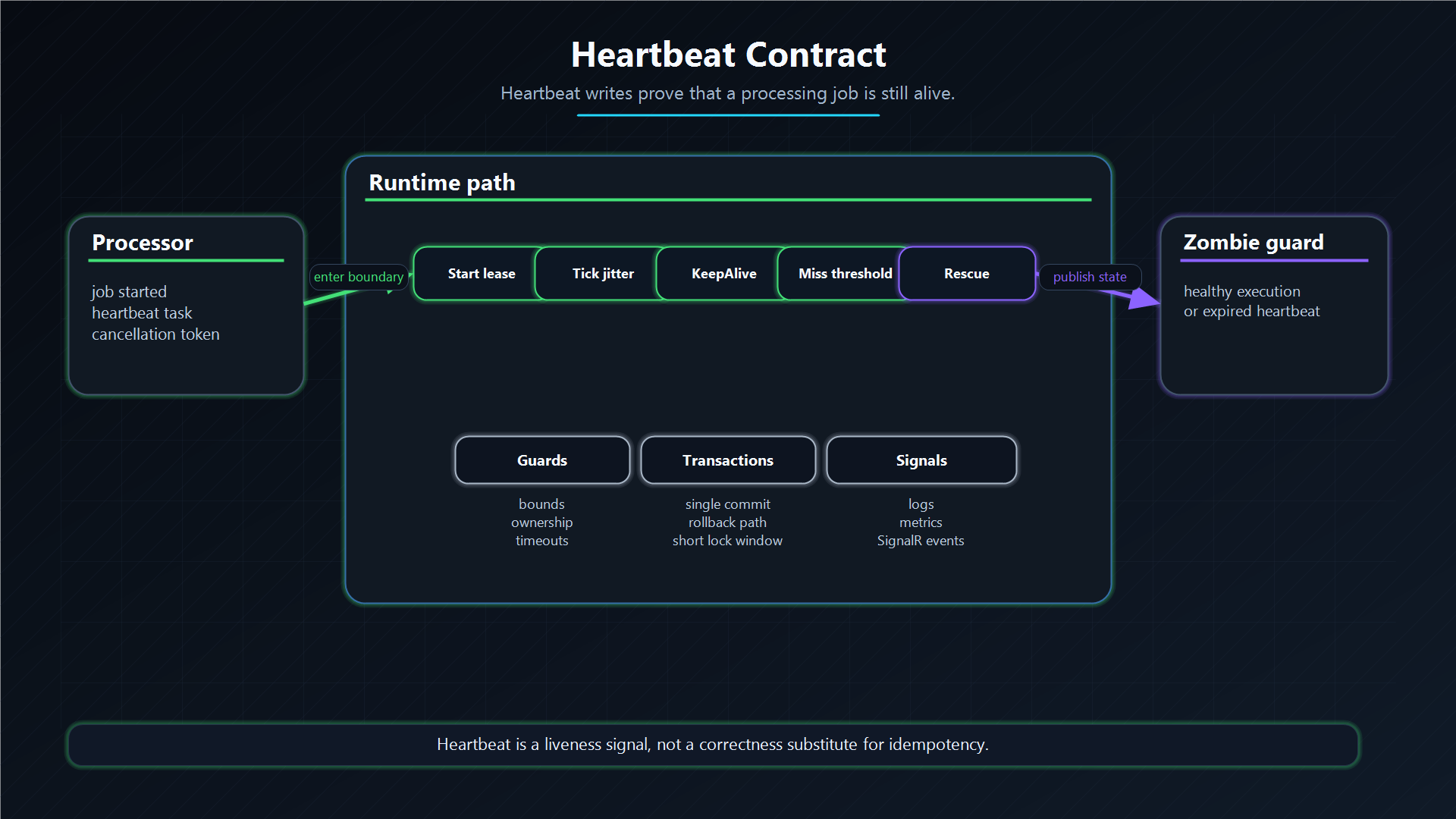
Heartbeat is how ChokaQ distinguishes a long-running healthy job from a job owned by a dead worker.
There are two heartbeat concepts:
| Heartbeat | Stored where | Purpose |
|---|---|---|
| Worker heartbeat | Process memory through IWorkerManager.LastHeartbeatUtc | Proves the local worker loop is alive for health checks. |
| Job heartbeat | JobsHot.HeartbeatUtc | Proves a specific processing job is still owned by a live execution. |
Job Heartbeat Contract
When a job moves to Processing, ChokaQ sets StartedAtUtc and HeartbeatUtc. While the handler is running, a heartbeat task periodically updates HeartbeatUtc.
Zombie rescue later checks processing rows whose heartbeat is older than the configured timeout. Those rows move to DLQ as Zombie so an operator can inspect side-effect risk before resurrection.
Why Heartbeat Instead Of Start Time?
Start time alone cannot distinguish a healthy long-running report from a dead worker. Heartbeat gives the worker a way to say: "This job is still executing."
Configuration
Important settings:
| Setting | Meaning |
|---|---|
Execution.HeartbeatIntervalMin / HeartbeatIntervalMax | Jittered interval for per-job heartbeat writes. |
Execution.HeartbeatFailureThreshold | Number of failed writes before degraded heartbeat state is reported. |
Execution.CancelOnHeartbeatFailure | Whether heartbeat write failure should cancel execution. |
Recovery.ProcessingZombieTimeout | Age after which a missing heartbeat turns processing work into zombie DLQ. |
Queues.*.ZombieTimeoutSeconds | Optional per-queue override. |
The zombie timeout must be comfortably larger than the heartbeat interval.
Failure Path
If heartbeat writes fail, ChokaQ records chokaq.jobs.heartbeat_failures. Depending on policy, the job may continue or be cancelled. If the process dies, heartbeat stops and zombie rescue eventually moves the job to DLQ.
Architecture Decision
Why this pattern?
Heartbeat is a lease freshness signal. It is cheaper and more explicit than assuming every long-running job is dead after a fixed start-time timeout.
Trade-offs
Heartbeat writes add database traffic. The interval must be long enough to avoid write noise and short enough to detect dead workers within the operational budget.
Alternatives considered
| Alternative | Benefit | Cost |
|---|---|---|
Timeout from StartedAtUtc only | Simple. | Kills healthy long-running jobs. |
| External worker registry only | Good process visibility. | Does not prove individual job progress. |
| No heartbeat | Less database traffic. | Dead workers leave processing rows ambiguous. |
Additional Questions
Why move heartbeat-expired jobs to DLQ?
Because user code may have already produced side effects. The operator must decide whether retry is safe.
What timeout values are dangerous?
Values close to the heartbeat interval. Normal jitter or transient SQL latency can make healthy jobs look dead.
What metric matters here?chokaq.jobs.heartbeat_failures, plus DLQ rows with FailureReason = Zombie.