
Architecture Decisions
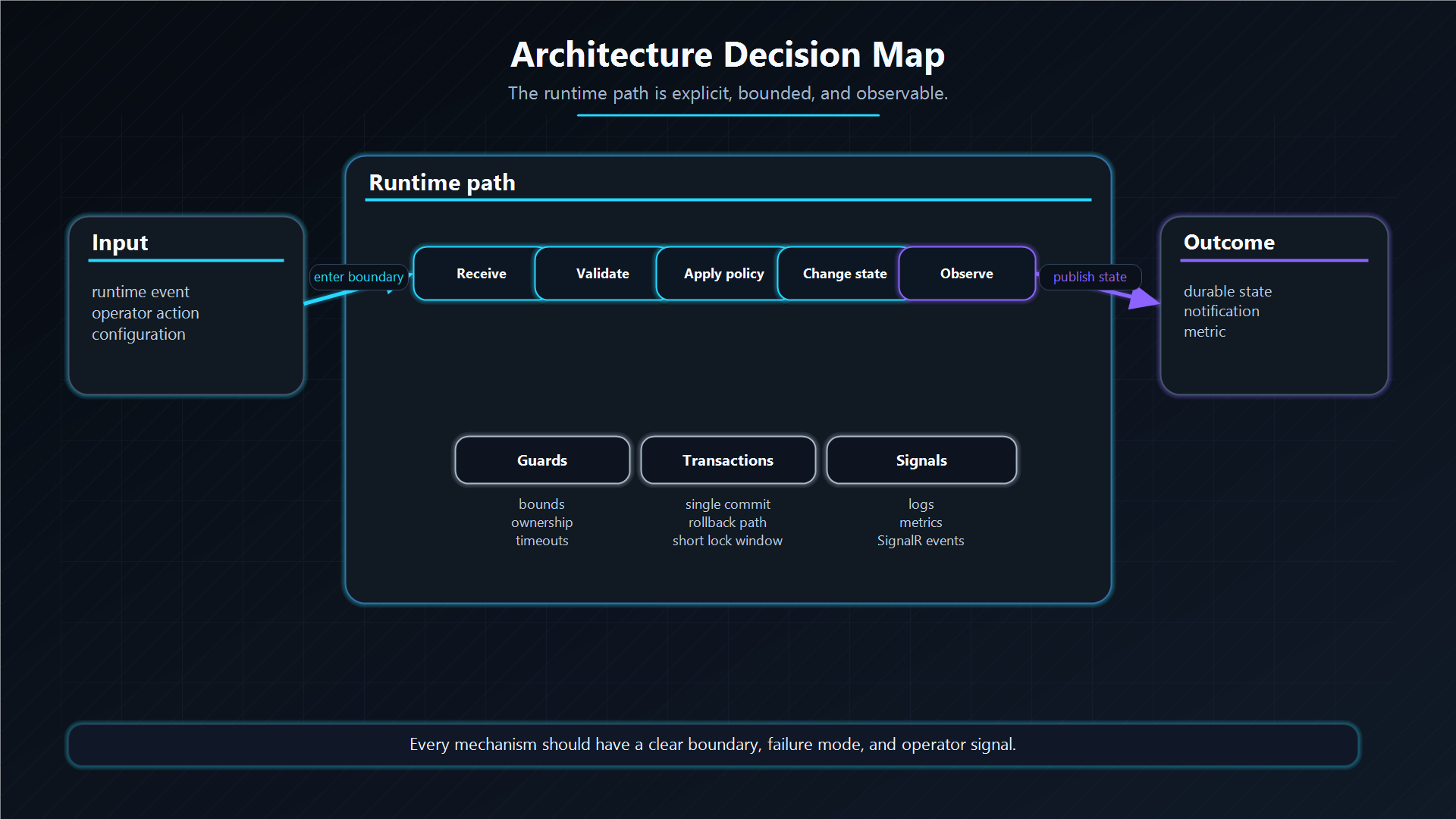
This page is the decision index for ChokaQ. It explains the major choices behind the runtime and points to the deep dives that defend each choice.
Decision Map
| Decision | Why it matters | Deep dive |
|---|---|---|
| SQL Server as the durable backend | Keeps accepted work restart-safe and inspectable. | Why SQL Server? |
| Three Pillars schema | Keeps active work separate from history and recovery evidence. | Three Pillars |
| At-least-once execution | Honest contract for durable work with external side effects. | Delivery Guarantees |
| Atomic Hot/Archive/DLQ moves | Prevents half-moved jobs. | Transaction Integrity |
UPDLOCK + READPAST fetch | Lets many workers claim work without central locks. | SQL Concurrency |
| Bounded prefetch | Keeps SQL as backlog and process memory bounded. | Bounded Prefetch |
| Retry + circuit breaker | Separates per-job retry from systemic failure protection. | Retry And DLQ, Circuit Breakers |
| DLQ instead of silent drop | Preserves failed work for repair and audit. | Failure Taxonomy |
| Heartbeat + zombie rescue | Distinguishes healthy long work from dead owners. | Heartbeat |
| The Deck as an operator surface | Makes repair workflows explicit and safer than ad hoc SQL. | Panel Guide |
Decision Quality Bar
Every major decision should be defendable with:
- the problem it solves;
- the operational consequence;
- the trade-off;
- the alternative that was rejected;
- the failure mode that still remains.
Additional Questions
What is the single most important design choice?
Using SQL as the durable coordination boundary. Everything else builds from that: fetch, retry, DLQ, observability, and operations.
What boundary does ChokaQ choose?
ChokaQ is a SQL-backed background job engine with strong operational visibility. It is not designed as a streaming platform, broker mesh, or distributed log.
Where is the hardest correctness boundary?
Between handler side effects and job finalization. ChokaQ protects its own state with transactions, but external side effects require idempotent handler design.