
SQL Transient Retry Policy
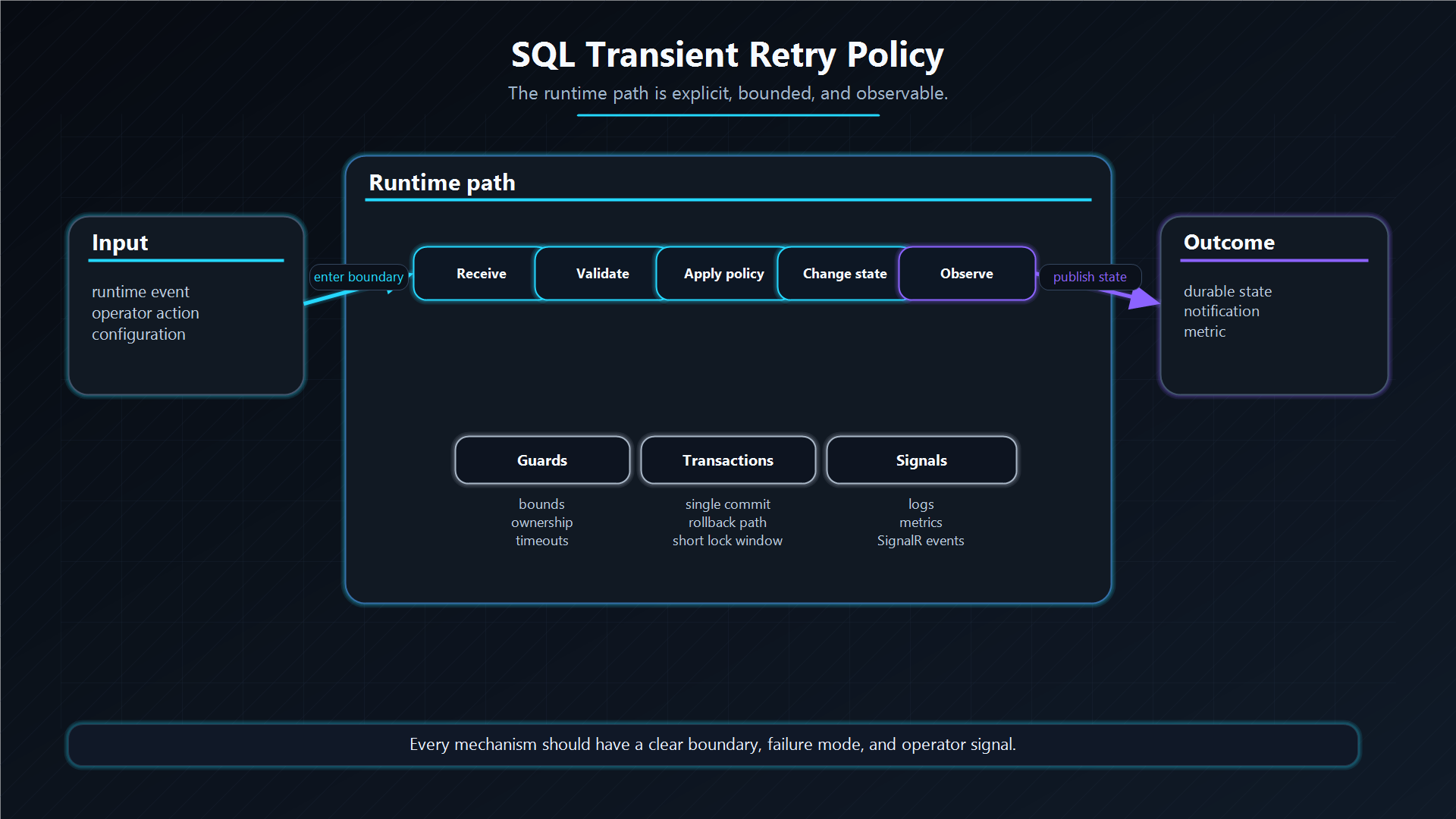
SQL transient retry policy handles short-lived SQL failures such as deadlocks, timeouts, service busy responses, and temporary database unavailability.
This policy is for ChokaQ's own storage operations. It is not the same as job handler retry.
Where It Lives
SqlRetryPolicy wraps calls inside SqlJobStorage.
Storage options:
| Setting | Purpose |
|---|---|
MaxTransientRetries | Maximum retry attempts for transient SQL exceptions. |
TransientRetryBaseDelayMs | Base delay for exponential backoff. |
CommandTimeoutSeconds | Timeout for individual SQL commands. |
Transient Errors
The policy treats these as retryable:
SqlException.IsTransient;1205deadlock;-2timeout;4060cannot open database;40197Azure SQL request processing error;40501service busy;40613database unavailable.
Backoff And Jitter
Delay grows exponentially:
baseDelayMs * 2^(attempt - 1)Jitter adds random spread so multiple workers do not retry in lockstep after a shared SQL blip.
Difference From Job Retry
| Retry type | Retries what? | Visible as job attempt? |
|---|---|---|
| SQL transient retry | ChokaQ storage operation. | No |
| Job retry | User handler execution. | Yes |
A transient SQL retry should not burn a job attempt unless the job actually reaches user-code execution.
Architecture Decision
Why this pattern?
ChokaQ needs a narrow SQL retry shape and avoids taking a general-purpose resilience dependency for one storage concern.
Trade-offs
A local policy is smaller and explicit, but less feature-rich than a general-purpose resilience library. If future provider behavior becomes more complex, this may deserve a pluggable policy.
Alternatives considered
| Alternative | Benefit | Cost |
|---|---|---|
| No SQL retry | Simple failure visibility. | Too brittle under deadlocks/network blips. |
| General-purpose resilience dependency | Mature resilience features. | Extra dependency for one narrow path. |
| Retry every SQL error | More aggressive recovery. | Can hide real bugs and overload SQL. |
Additional Questions
Why not count SQL retry as job retry?
Because user code did not run. Job attempts track handler execution, not storage plumbing retries.
Why add jitter?
To avoid workers retrying at the same time after a shared outage.
What errors should not be retried?
Schema errors, invalid SQL, permission failures, and data contract violations.