
CHK-02: Job State Machine
The Path of a Job
Every job in ChokaQ follows a deterministic path through a series of states. Understanding this path is the key to understanding the entire system.
The States
| Status | Value | Location | Meaning |
|---|---|---|---|
| Pending | 0 | JobsHot | Waiting in queue — ready to be picked up |
| Fetched | 1 | JobsHot | Pulled into worker memory buffer — waiting for processing slot |
| Processing | 2 | JobsHot | Actively executing — heartbeat ticking |
| Succeeded | 3 | JobsArchive | Completed successfully — moved to archive |
| Failed | 4 | JobsDLQ | Failed permanently — moved to DLQ for inspection |
| Cancelled | 5 | JobsDLQ | Admin cancelled — retained in DLQ/history workflow |
| Zombie | 6 | JobsDLQ | Worker crashed — heartbeat expired |
📝 Note
Statuses 3–6 are virtual in SQL Server mode. The job doesn't actually have a Status column set to 3 — it's simply moved to the JobsArchive table. These enum values exist for SignalR notifications and the In-Memory storage mode.
The Full Lifecycle
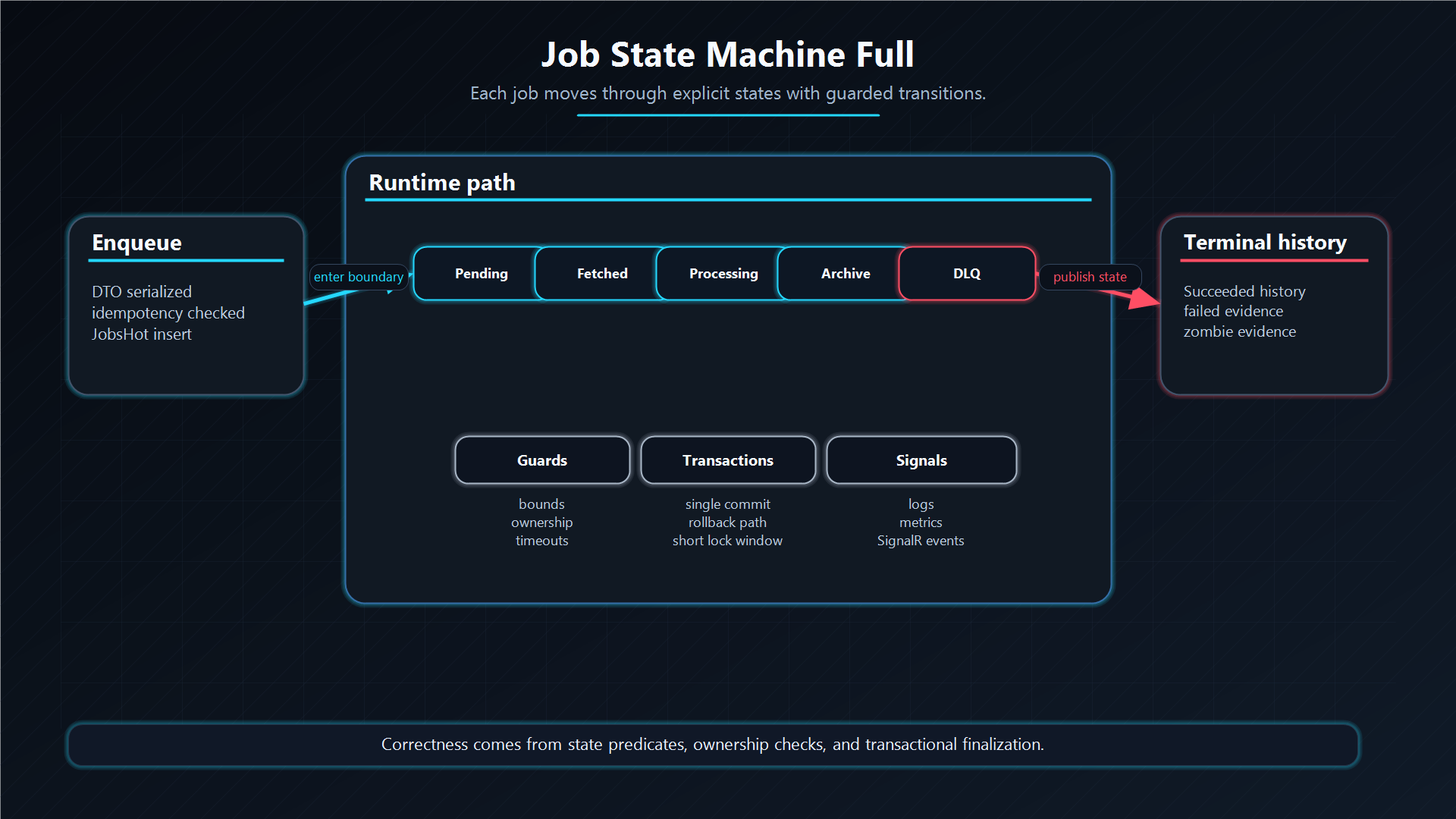
Phase 1: Enqueue
When IChokaQQueue.EnqueueAsync() is called:
await _queue.EnqueueAsync(
    new SendEmailJob("user@example.com", "Welcome!"),
    priority: 20,              // Higher = processed first
    delay: TimeSpan.FromMinutes(5),  // Optional delayed execution
    idempotencyKey: "email-user-123" // Optional duplicate prevention
);
What happens internally:
- Generate unique ID (
ULIDformat for time-sortable IDs) - Serialize job DTO to JSON
- Idempotency check: If key exists → return existing job ID, skip insert
- Insert into
JobsHotwithStatus = 0 (Pending) - Set
ScheduledAtUtcif delay is specified - Record
chokaq.jobs.enqueuedmetric - Push notification via SignalR
Idempotency Guard
-- Check BEFORE insert to avoid unique constraint violations
SELECT [Id] FROM [chokaq].[JobsHot]
WHERE [IdempotencyKey] = @Key;

-- If found → return existing ID, done
-- If not → proceed with INSERT
Plus a unique filtered index as a safety net:
CREATE UNIQUE NONCLUSTERED INDEX [IX_JobsHot_Idempotency]
ON [chokaq].[JobsHot] ([IdempotencyKey])
WHERE [IdempotencyKey] IS NOT NULL
Scope note:
- Built-in enqueue idempotency is
JobsHot-only. - It prevents duplicate active work with the same business key.
- Once the original job moves to Archive or DLQ, the same key can be enqueued again as a new logical attempt.
- Long-lived "already completed" memory belongs to the optional idempotency middleware's completion marker, not to the Hot queue index. This marker is not handler result replay and does not create exactly-once side effects.
Phase 2: Fetch (Pending → Fetched)
The SqlJobWorker's fetcher loop runs on a polling interval:
// Simplified from SqlJobWorker.cs
while (!ct.IsCancellationRequested)
{
    var batch = await _storage.FetchNextBatchAsync(
        workerId: _workerId,
        batchSize: _options.BatchSize,
        allowedQueues: activeQueues
    );

    foreach (var job in batch)
    {
        // Push into bounded Channel<T> (Prefetch Buffer)
        await _channel.Writer.WriteAsync(job, ct);
    }

    await Task.Delay(_options.PollingInterval, ct);
}
The fetch query atomically:
- Selects top N pending jobs (respecting priority, schedule, and bulkhead limits)
- Sets
Status = 1 (Fetched)and assignsWorkerId - Returns the locked rows
Phase 3: Process (Fetched → Processing)
The consumer loop reads from the Prefetch Buffer:
// For each job from the channel:
await _semaphore.WaitAsync(ct);      // DynamicConcurrencyLimiter — concurrency control
try
{
    await _processor.ProcessAsync(job, ct);
}
finally
{
    _semaphore.Release();
}
Inside ProcessAsync():
- Circuit Breaker check → is this job type allowed to execute?
- Mark as Processing →
Status = 2, setHeartbeatUtcandStartedAtUtc - Start heartbeat task → updates
HeartbeatUtcevery N seconds (parallel) - Dispatch to handler → Expression Tree compiled delegate invocation
- Middleware pipeline → wraps handler in onion-model middleware stack
- Result handling → Success, Fatal, or Transient path
Heartbeat Mechanism
While the job is processing, a parallel task keeps it alive:
// Simplified heartbeat logic
_ = Task.Run(async () =>
{
    while (!jobCt.IsCancellationRequested)
    {
        await Task.Delay(
            RandomBetween(
                options.Execution.HeartbeatIntervalMin,
                options.Execution.HeartbeatIntervalMax),
            jobCt);
        await _storage.KeepAliveAsync(jobId, jobCt);
    }
});
This prevents the ZombieRescueService from archiving a long-running but healthy job.
Phase 4a: Success (Processing → Archive)
var durationMs = stopwatch.Elapsed.TotalMilliseconds;
await _storage.ArchiveSucceededAsync(job.Id, durationMs);
_breaker.ReportSuccess(job.Type);
_metrics.RecordSuccess(job.Queue, job.Type, durationMs);
The job is atomically moved to JobsArchive with execution duration recorded.
Phase 4b: Transient Failure (Processing → Pending, retry)
if (!IsFatalException(ex) && job.AttemptCount < options.Retry.MaxAttempts)
{
    var backoffMs = CalculateBackoffMs(job.AttemptCount + 1);
    var nextRun = DateTime.UtcNow.AddMilliseconds(backoffMs);

    await _storage.RescheduleForRetryAsync(
        job.Id, nextRun, job.AttemptCount + 1, ex.Message);
}
The job stays in JobsHot but:
Status→ back to0 (Pending)AttemptCount→ incrementedScheduledAtUtc→ set to future time (backoff)- Won't be fetched until
ScheduledAtUtcpasses
Phase 4c: Fatal Failure / Exhaustion (Processing → DLQ)
await _storage.ArchiveFailedAsync(job.Id, ex.ToString());
_breaker.ReportFailure(job.Type);
_metrics.RecordFailure(job.Queue, job.Type, ex.GetType().Name);
The job is atomically moved to JobsDLQ with full exception details stored in ErrorDetails.
Phase 5: Resurrection (DLQ → Hot)
For the failure categories that lead to DLQ, see Failure Taxonomy. For shutdown and cancellation behavior around active work, see Graceful Shutdown and Job Context And Cancellation.
Via The Deck dashboard or programmatically:
await _storage.ResurrectAsync(
    jobId: "job-123",
    updates: new JobDataUpdateDto
    {
        Payload = fixedJson,      // Optional: fix the broken payload
        Tags = "retried,manual",  // Optional: add audit tags
        Priority = 30             // Optional: boost priority
    },
    resurrectedBy: "admin@company.com"
);
The job returns to JobsHot with:
Status = 0 (Pending)AttemptCount = 0(fresh start)- Modified payload/tags/priority (if provided)
Next: Learn how Bulkhead Isolation prevents heavy jobs from starving lightweight ones.