
Idempotent Handler Checklist
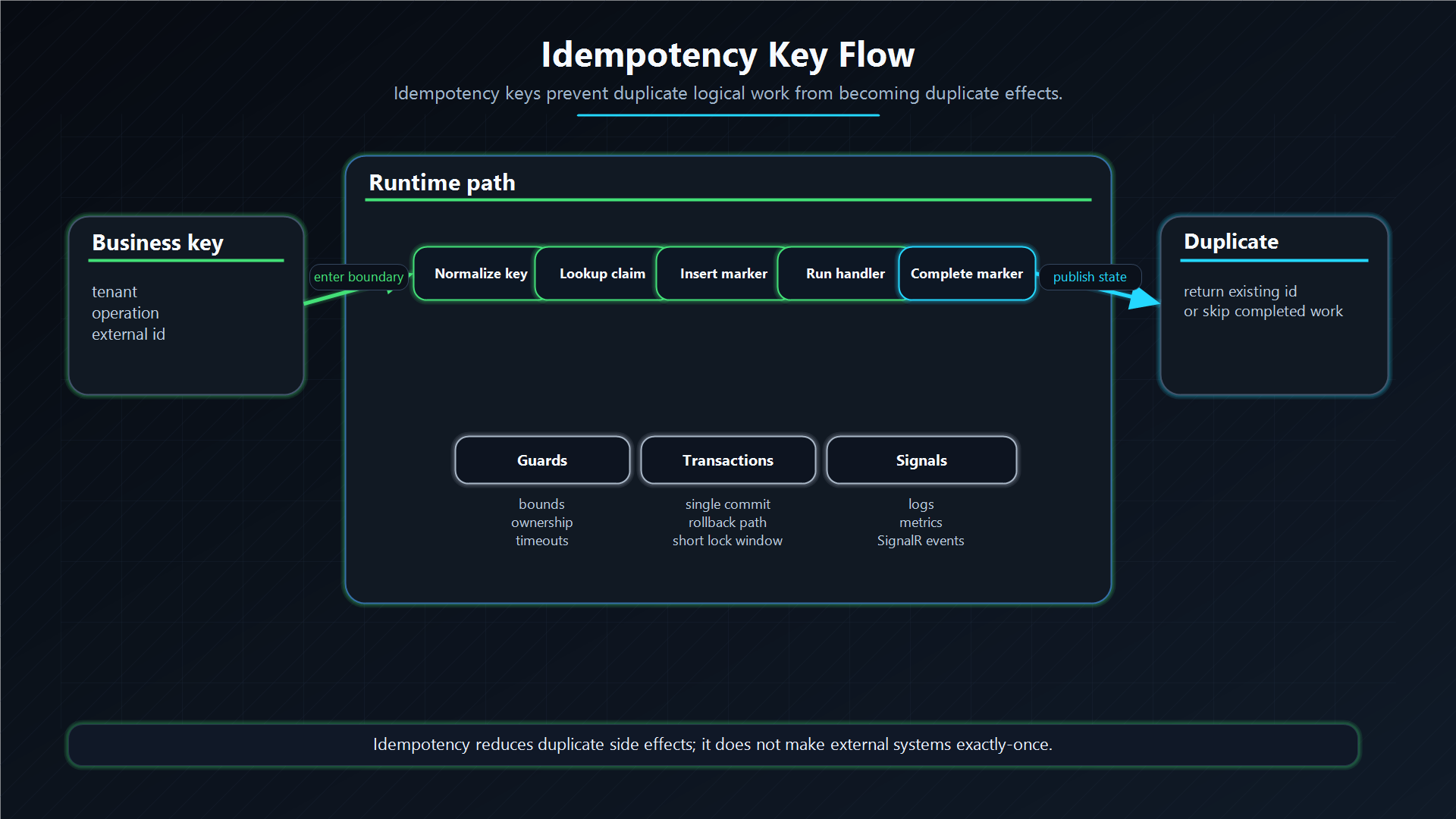
ChokaQ provides at-least-once execution. A handler can run more than once if a worker crashes after user code produces a side effect but before finalization is stored. Make every side-effecting handler idempotent.
Required Decisions
| Question | Recommended answer |
|---|---|
| What is the business idempotency key? | Use order ID, invoice ID, webhook event ID, payment attempt ID, or another stable domain key. |
| Where is the key enforced? | Prefer the system that owns the side effect: database unique constraint, provider idempotency key, or outbox. |
| How long can duplicates arrive? | Set idempotency TTL from business reality, not from retry settings alone. |
| What happens after partial side effects? | Store enough state to retry safely or send the job to manual review. |
Patterns
- Database unique constraint plus upsert.
- Payment/email/webhook provider idempotency key.
- Outbox table for local transaction plus later publish.
- Read-before-write when repeating the handler converges to the same state.
- Manual review for operations that cannot be made safe to repeat.
ChokaQ Middleware Boundary
The optional idempotency middleware writes an InProgress claim before handler execution, skips concurrent duplicates, and writes a completion marker after success. It reduces duplicate handler execution for one active key, but it does not make external systems exactly-once.
Relevant metrics:
| Metric | Outcome examples |
|---|---|
chokaq.idempotency.claims | claimed, completed, completed_duplicate, in_progress_duplicate, released, complete_conflict, empty_key |
Investigate complete_conflict: it means handler execution finished, but the completion marker could not be stored for that key/job pair.
Architecture Decision
Why this pattern?
At-least-once execution is honest but pushes duplicate side-effect safety to the business boundary. Idempotent handlers are the application-level answer.
Trade-offs
Idempotency adds data modeling and retention decisions. The cost is necessary for payments, email, webhooks, and external writes.
Alternatives considered
| Alternative | Benefit | Cost |
|---|---|---|
| Trust queue exactly-once | Simple. | False assumption for real crashes. |
| Disable retries | Avoids retry duplicates. | Loses resilience and still does not solve crash windows. |
| Provider idempotency only | Strong where available. | Not every dependency supports it. |
Additional Questions
Why is handler idempotency required?
Because a job can execute more than once after crash/recovery.
What is the hardest duplicate window?
External side effect succeeds, then the process crashes before ChokaQ archives the job.
What should payment jobs use?
A provider-supported idempotency key tied to the business payment attempt.