
Health Checks
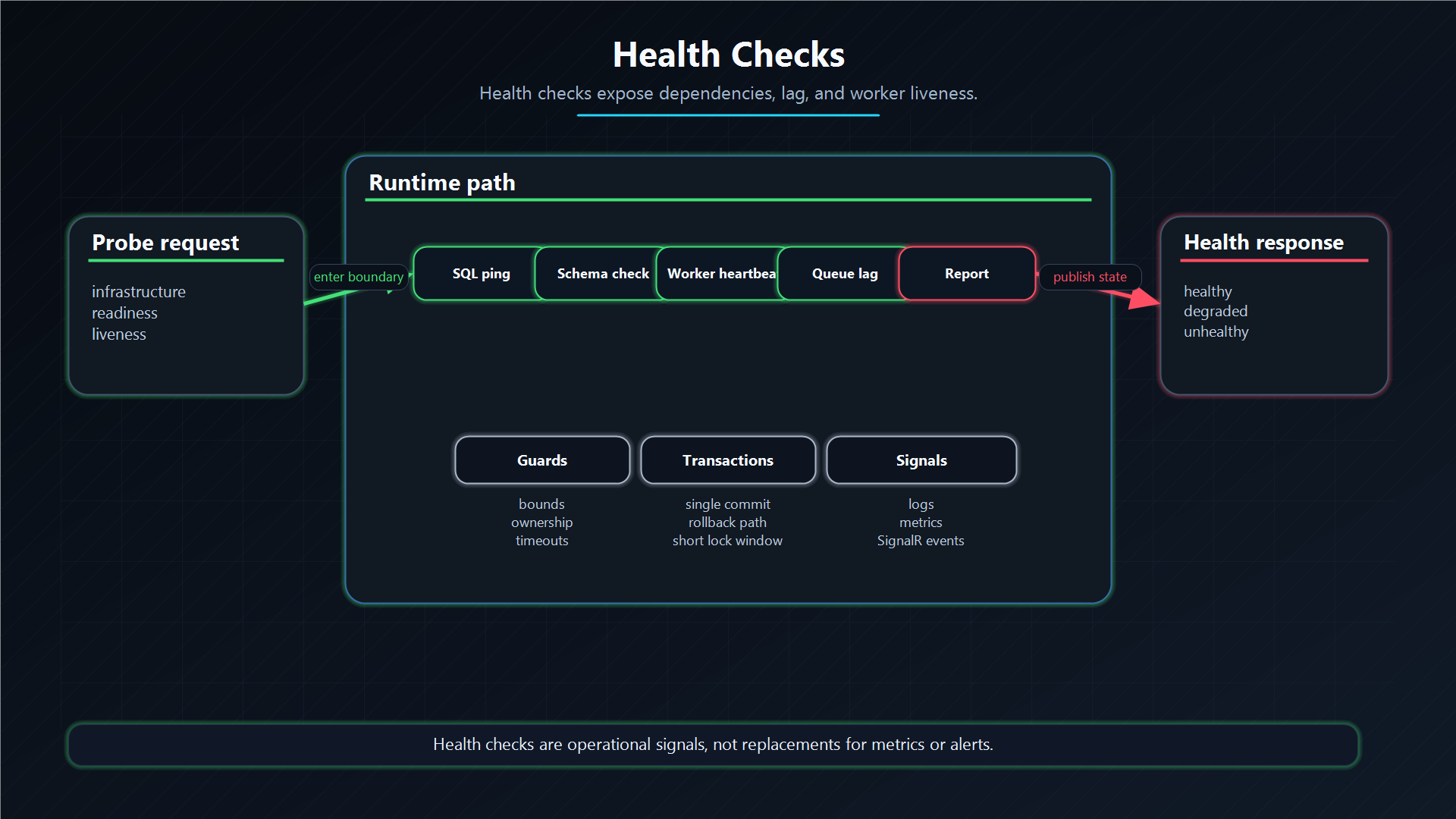
ChokaQ health checks answer whether a host and its durable queue boundary are usable from an infrastructure point of view.
They do not replace metrics. Health checks are point-in-time status; metrics show trends.
Health Surfaces
| Check | Purpose |
|---|---|
| SQL connectivity | Can the host open SQL and see required ChokaQ tables? |
| Worker heartbeat | Did the local worker loop enter and keep cycling? |
| Queue saturation | Is eligible work waiting longer than the configured budget? |
SQL Connectivity
The SQL health check verifies:
- connection open succeeds;
- configured schema exists;
- required tables exist:
JobsHot,JobsArchive,JobsDLQ,StatsSummary,MetricBuckets, andQueues; - command timeout policy is applied.
Connectivity alone does not prove runtime readiness. A database can be reachable but missing the runtime schema.
Worker Heartbeat
The worker health check is process-local. It reports:
- active worker count;
- total worker capacity;
- running state;
- last worker heartbeat;
- heartbeat age.
This catches a host whose SQL connection is fine but whose background service is not actually running.
Queue Saturation
Queue saturation uses lag, not just depth. It looks at eligible pending work and reports degraded/unhealthy when the worst queue exceeds configured thresholds.
Depth asks: "How many jobs exist?"
Lag asks: "How long has actionable work waited?"
Architecture Decision
Why this pattern?
Background job health has multiple dimensions. A single "SQL reachable" check cannot prove that workers are alive or that the system is keeping up.
Trade-offs
Queue lag health can mark a host degraded even when the process is technically alive. That is intentional: a queue processor that cannot keep up is an operational problem.
Alternatives considered
| Alternative | Benefit | Cost |
|---|---|---|
| Liveness-only endpoint | Simple. | Misses broken workers and saturated queues. |
| SQL-only endpoint | Validates storage. | Misses dead background loops. |
| Metrics-only alerting | Great for trends. | Not ideal for readiness probes. |
Additional Questions
Why use queue lag instead of depth?
Depth lacks job duration context. Lag measures user-visible waiting time for eligible work.
Can health be green while DLQ grows?
Yes. DLQ growth is usually an alert/metric problem, not necessarily a readiness failure.
Should health endpoints be public?
No. They should be infrastructure-scoped or protected.