
Architecture Q&A
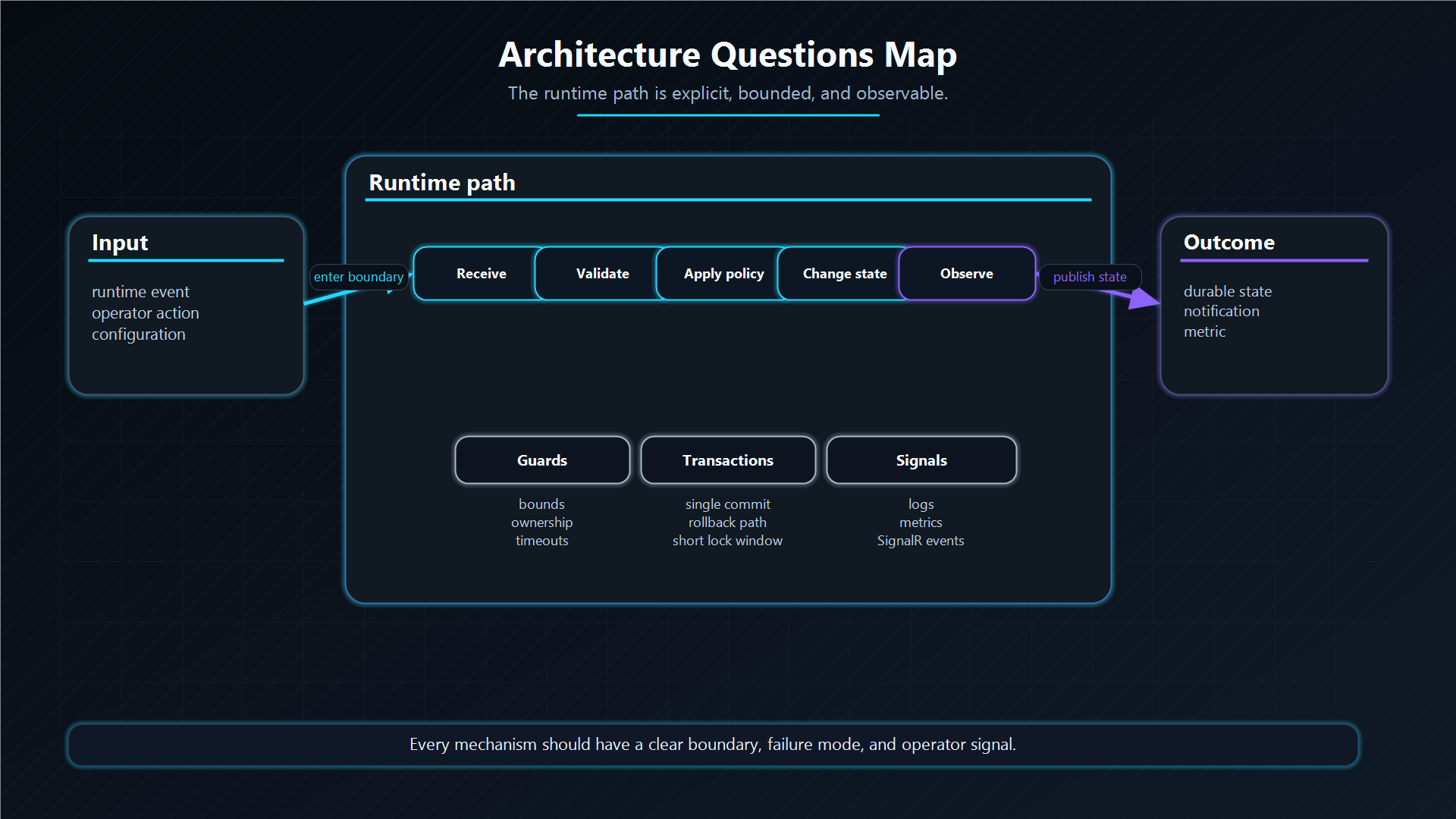
This guide prepares ChokaQ for a senior architecture review or system-design discussion. The goal is not to memorize implementation trivia. The goal is to show that each important design has a reason, a cost, and a recovery story.
The One-Minute Pitch
ChokaQ is a .NET background job engine backed by SQL Server. It stores active jobs in JobsHot, successful jobs in JobsArchive, and failed/operator-held jobs in JobsDLQ. Workers claim rows with SQL locking, process them through a typed or raw dispatcher, and finalize state through atomic SQL transitions. The Deck provides real-time operational inspection and repair workflows.
Additional Architecture Questions
Why SQL Server?
Because the product optimizes for durable business jobs, inspectability, and operator repair. SQL gives transactional state, familiar backup/restore, queryable evidence, and a simple deployment story for teams already running SQL.
Trade-off: SQL becomes the central throughput boundary. If the workload needs massive streaming throughput, a broker/log may be better.
Why not exactly-once?
Exactly-once external side effects are not something a queue engine can promise for arbitrary handlers. ChokaQ promises at-least-once execution and provides tools for idempotency, DLQ, heartbeat, and recovery.
Why Hot/Archive/DLQ instead of one table?
Active fetch should not compete with years of history. The split keeps the hot worker path small while preserving audit and repair data.
What happens on worker crash?
Fetched jobs that did not start user code can return to pending. Processing jobs with expired heartbeat move to DLQ as zombies because side effects may already exist.
Why have The Deck?
A durable queue without an operator surface pushes recovery into ad hoc SQL. The Deck turns repair into authenticated, bounded, observable workflows.
What To Admit Honestly
- SQL will not beat a dedicated broker for huge streaming workloads.
- At-least-once requires handler idempotency.
- Dashboard actions need serious authorization.
- Prefetching adds a stale-ownership window that must be guarded.
- Retention and DLQ policy are operational responsibilities.
Strong Close
ChokaQ is production-oriented because it does not hide failure. It stores state, classifies failure, exposes operations, and forces dangerous actions through explicit control points.