
Serialization And Envelope Limits
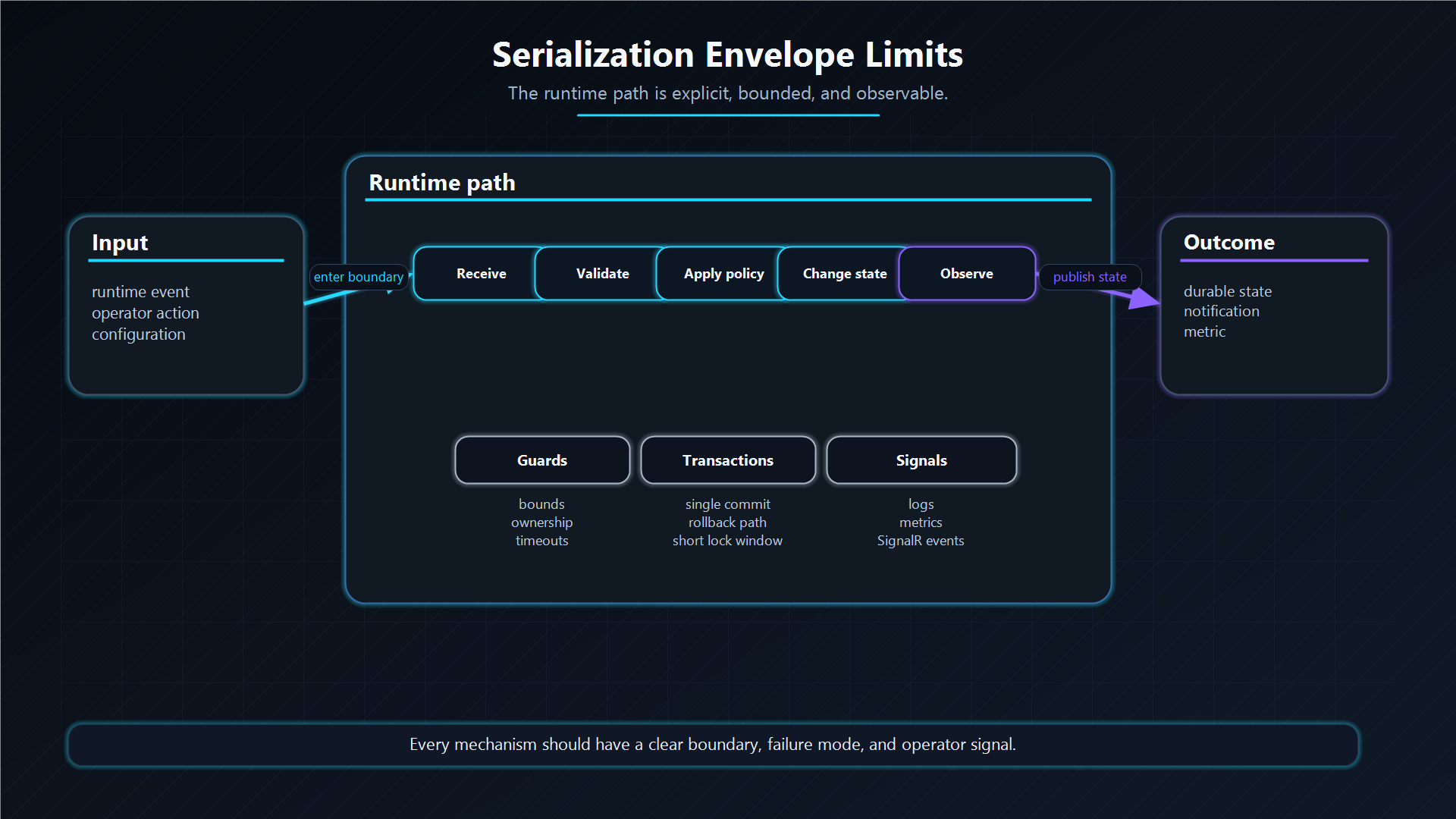
Serialization turns a typed job object into durable payload text. Envelope validation protects the storage contract around that payload: queue name, type key, creator, tags, idempotency key, and payload size.
The payload is business data. The envelope is ChokaQ routing and operational metadata.
Where It Lives
| Area | Runtime type |
|---|---|
| JSON serializer | SystemTextJsonChokaQJobSerializer |
| Serializer options | ChokaQSerializationOptions |
| Envelope validation | ChokaQEnvelopeLimits |
| Type key lookup | JobTypeRegistry |
Payload Serialization
Bus mode serializes the job DTO with System.Text.Json using configured serializer options. During dispatch, the persisted type key resolves to a CLR type and the payload is deserialized into that type.
Pipe mode keeps the payload as raw JSON/text and passes it to one global pipe handler.
Envelope Limits
ChokaQ validates:
| Field | Limit |
|---|---|
| Queue | 255 characters |
| Type key | 255 characters |
| CreatedBy | 100 characters |
| Tags | 1000 characters |
| Idempotency key | 255 characters |
| Payload | Serialization.MaxPayloadBytes |
These limits match storage reality and prevent accidental unbounded operational metadata.
Contract Versioning
Persisted payloads can outlive deployments. Treat job DTOs like message contracts:
- prefer additive changes;
- avoid renaming required fields without a compatibility plan;
- use semantic type keys such as
email.send.v1; - register
v2side by side when breaking payload shape; - keep old handlers until old rows drain or are migrated.
Architecture Decision
Why this pattern?
ChokaQ uses a simple JSON payload contract because it is inspectable in SQL and The Deck, easy to version, and natural for .NET applications.
Trade-offs
JSON is larger than binary formats and schema compatibility is a developer discipline. The benefit is operational readability and lower dependency burden.
Alternatives considered
| Alternative | Benefit | Cost |
|---|---|---|
| Binary serialization | Smaller/faster. | Harder inspection and version debugging. |
| Persist CLR object graph | Convenient. | Fragile across deployments. |
| External schema registry | Strong governance. | More infrastructure and friction for preview scope. |
Additional Questions
Why validate envelope length before storage?
Because database columns and indexes have finite limits. Failing early produces clear errors instead of SQL truncation or index failures.
Why use semantic type keys?
Because serialized rows outlive CLR refactors.
What is the breaking-change strategy?
Register a new type key, keep old handlers during migration, then retire old contracts after retention or explicit migration.