
Metrics
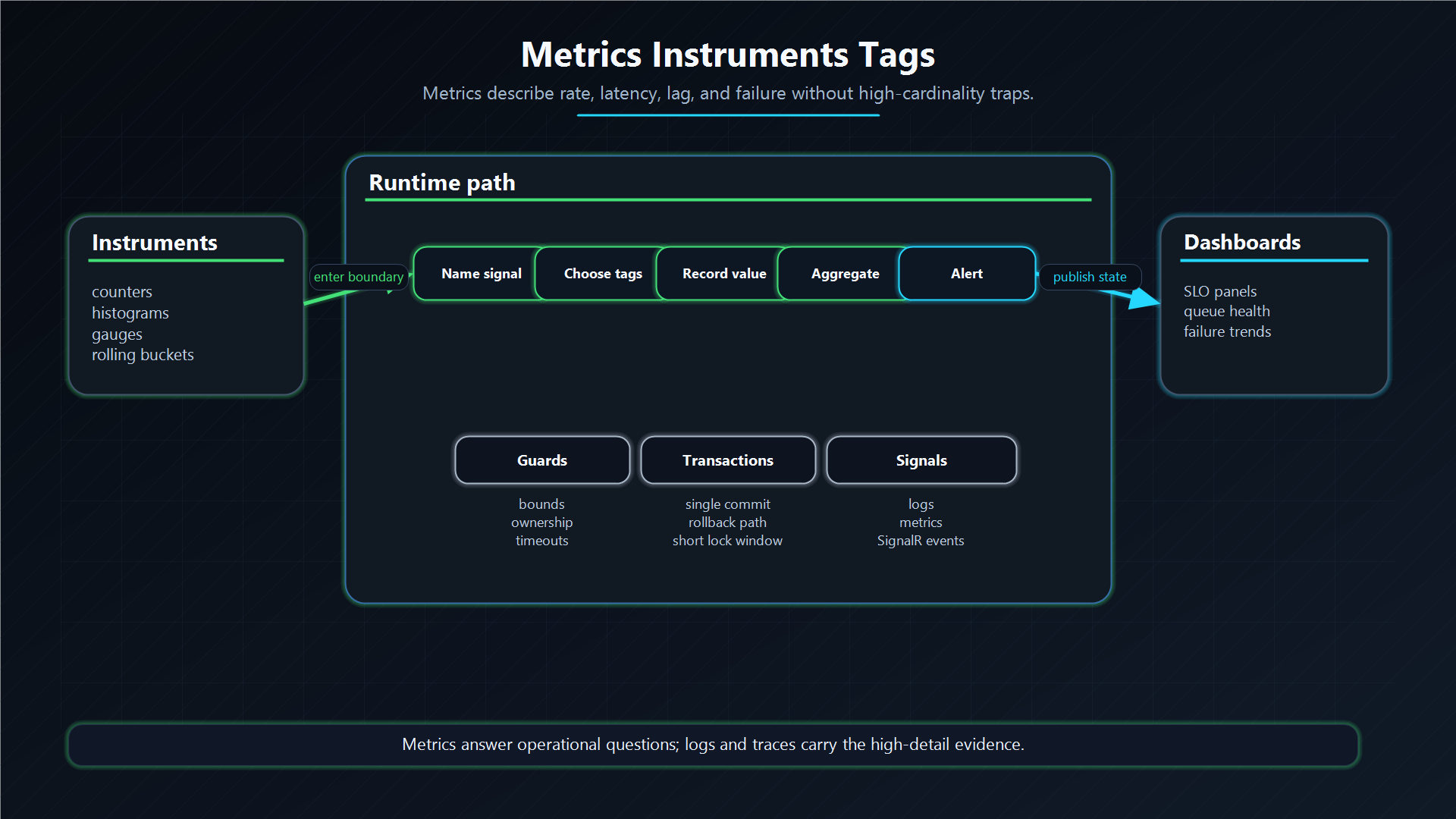
ChokaQ exposes metrics through the .NET System.Diagnostics.Metrics API. The meter name is ChokaQ.
Metrics are a public production contract. Names, units, and tag cardinality need to be stable enough for dashboards and alerts.
Instruments
| Metric | Type | Meaning |
|---|---|---|
chokaq.jobs.enqueued | Counter | Jobs accepted into the queue. |
chokaq.jobs.completed | Counter | Jobs completed successfully. |
chokaq.jobs.failed | Counter | Handler execution failures. |
chokaq.jobs.processing_duration | Histogram, ms | Handler processing duration. |
chokaq.jobs.queue_lag | Histogram, ms | Time eligible jobs waited before processing. |
chokaq.jobs.dlq | Counter | Jobs moved to DLQ. |
chokaq.jobs.retried | Counter | Jobs scheduled for retry. |
chokaq.workers.active | UpDownCounter | Current active processing workers. |
chokaq.jobs.heartbeat_failures | Counter | Failed heartbeat writes. |
chokaq.jobs.state_transition_conflicts | Counter | Worker-owned transitions that affected no rows. |
chokaq.idempotency.claims | Counter | Idempotency claim outcomes. |
chokaq.circuits.events | Counter | Circuit breaker state events. |
Cardinality Control
Metrics tags are capped by ChokaQ:Metrics options:
- max queue tag values;
- max job type tag values;
- max error tag values;
- max failure reason tag values;
- max tag value length;
- unknown value label;
- overflow value label.
When a process sees too many distinct values, new values collapse into the overflow label instead of creating unlimited time series.
Alerting Guidance
| Signal | Use |
|---|---|
| Queue lag p95/p99 | Primary saturation alert. |
| DLQ rate | Terminal failure alert. |
| Retry rate | Downstream instability signal. |
| Heartbeat failures | Storage or worker health issue. |
| State transition conflicts | Ownership/race/recovery signal. |
| Circuit events | Systemic downstream failure protection. |
Architecture Decision
Why this pattern?
OpenTelemetry-compatible metrics let ChokaQ integrate with existing monitoring without taking a dependency on a specific vendor.
Trade-offs
Tag cardinality must be controlled. Queue names, job types, and error values can become unbounded if applications feed dynamic strings into them.
Alternatives considered
| Alternative | Benefit | Cost |
|---|---|---|
| Vendor-specific SDK | Rich features. | Locks users into one observability stack. |
| Logs-derived metrics | Flexible. | Slower and more expensive for alerting. |
| No built-in metrics | Small runtime surface. | Weak production story. |
Additional Questions
Why is queue lag more important than queue depth?
Depth lacks time context. Lag tells you how long eligible work is actually waiting.
Why cap tag values?
To prevent accidental high-cardinality time series from damaging the monitoring backend.
What metric indicates duplicate-protection behavior?chokaq.idempotency.claims, split by outcome.