
Job Context And Cancellation
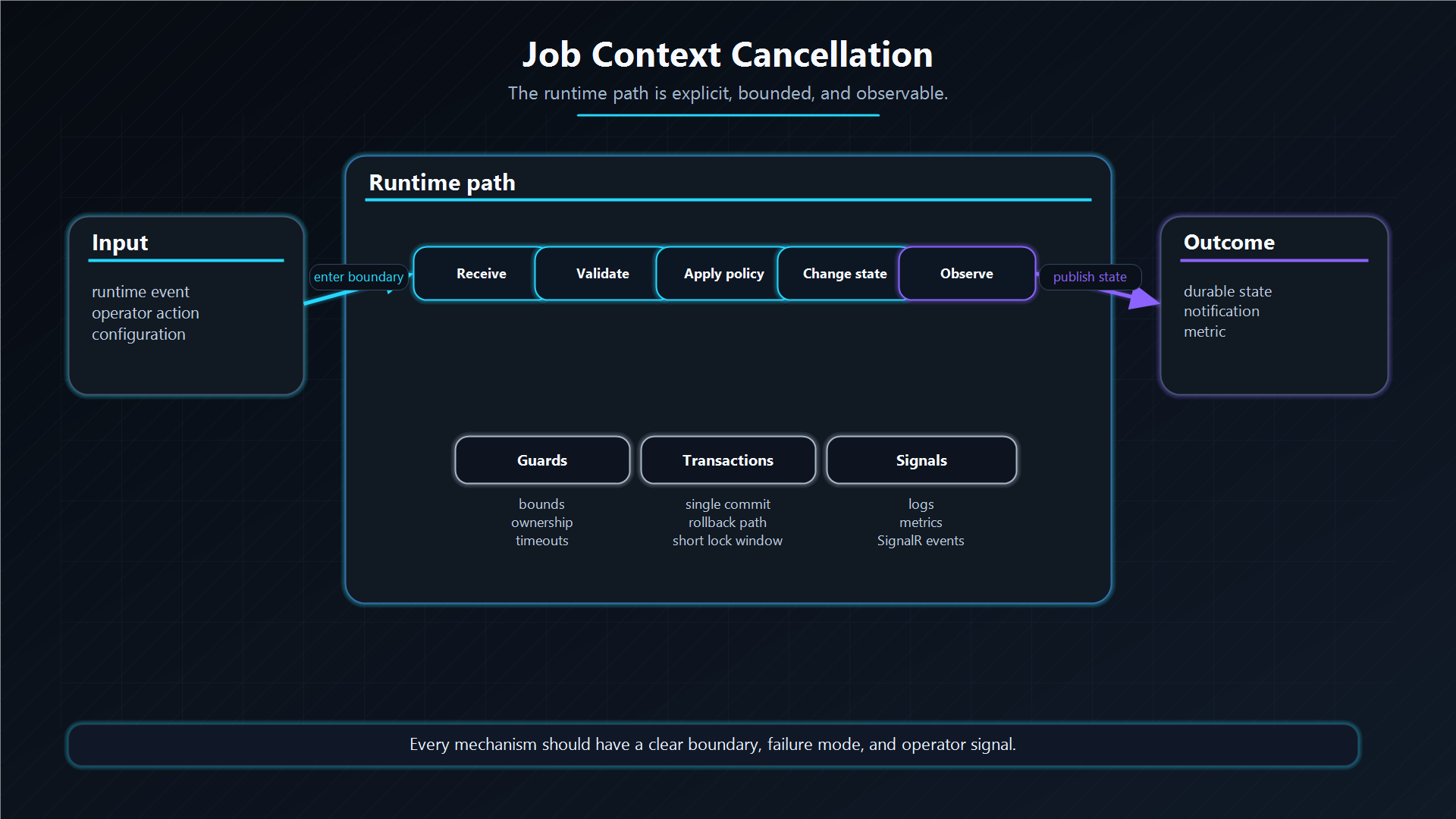
IJobContext gives handlers access to execution context without exposing worker internals.
Handlers can:
- read the current
JobId; - observe the current execution
CancellationToken; - report progress to The Deck.
Context Surface
public interface IJobContext
{
    string JobId { get; }
    CancellationToken CancellationToken { get; }
    Task ReportProgressAsync(int percentage);
}
Cancellation Sources
The execution token can be cancelled by:
| Source | Meaning |
|---|---|
| Handler timeout | Execution exceeded configured runtime budget. |
| Admin cancellation | Operator requested stop from The Deck or worker API. |
| Worker shutdown | Host is stopping and execution should finish or cancel. |
Cancellation is cooperative. Handlers must pass the token to downstream async calls and check it in long-running loops.
Progress Reporting
ReportProgressAsync clamps progress to 0..100 and notifies The Deck through the runtime notifier. Progress is a UI signal, not a state transition.
Developer Guidance
Good handlers:
- pass
CancellationTokento database, HTTP, storage, and SDK calls; - avoid swallowing
OperationCanceledException; - report progress only at meaningful boundaries;
- keep external side effects idempotent;
- do not assume cancellation means rollback happened downstream.
Architecture Decision
Why this pattern?
The handler needs execution context, but it should not know about workers, SignalR, SQL leases, or cancellation registries. IJobContext keeps the public surface small.
Trade-offs
The context is intentionally limited. It does not expose mutable job state or storage APIs because that would let handlers bypass lifecycle policy.
Alternatives considered
| Alternative | Benefit | Cost |
|---|---|---|
| Pass worker object to handlers | Maximum power. | Breaks encapsulation and lifecycle safety. |
| Ambient static context | Convenient. | Harder tests and hidden coupling. |
| No context | Simple. | No progress reporting or job-local cancellation surface. |
Additional Questions
Is cancellation guaranteed to stop side effects?
No. It is cooperative. Downstream systems may already have accepted work.
Why not expose storage from context?
Because handlers should not perform lifecycle transitions directly.
What should a handler do with the token?
Pass it to all cancellable async operations and stop cleanly when requested.