
Schema Bootstrap And Migrations
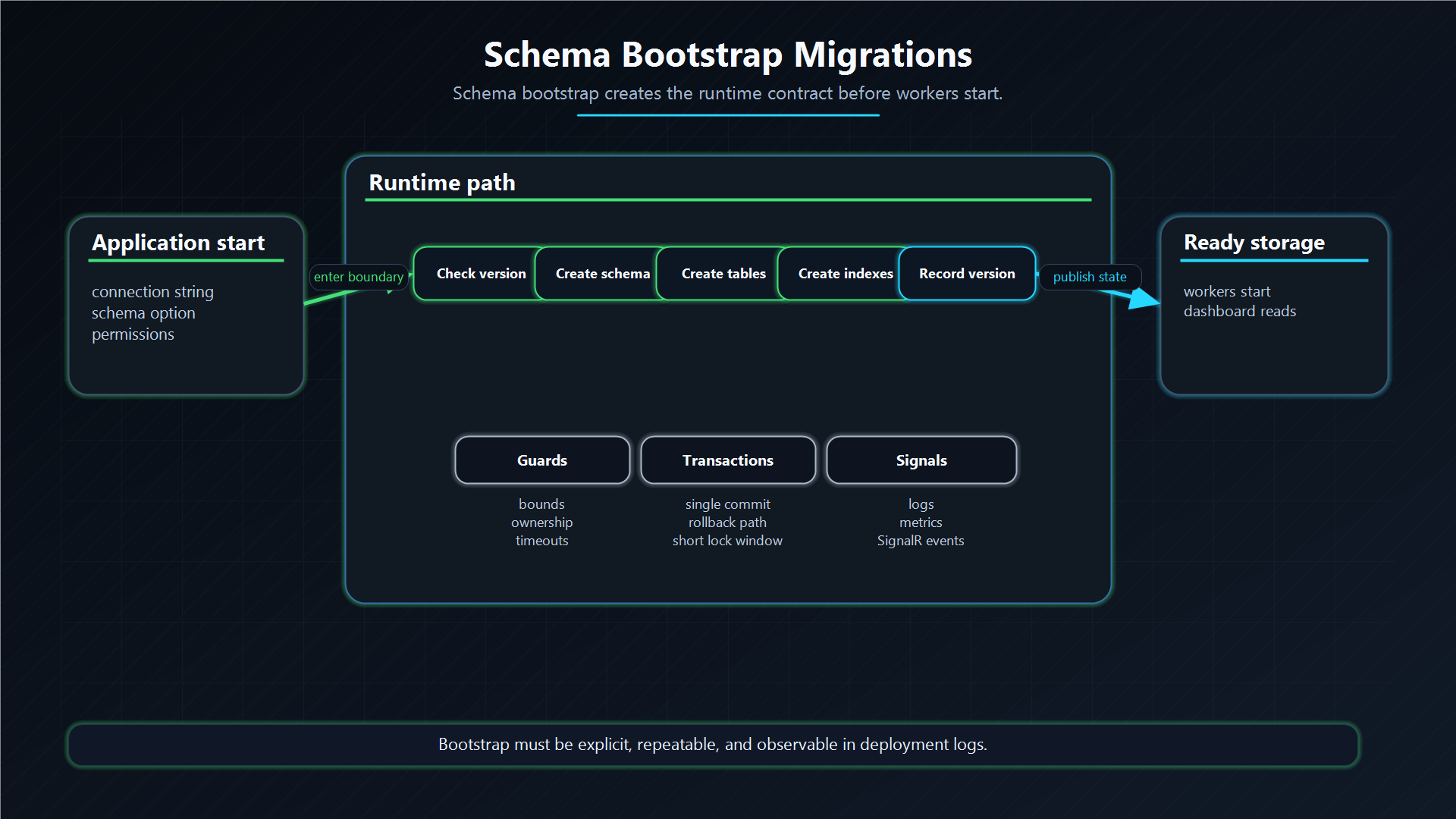
ChokaQ can initialize its SQL schema at startup when AutoCreateSqlTable is enabled. This is useful for local development, samples, and controlled environments where the application identity has schema permissions.
Startup Flow
DbMigrationWorkerstarts with the host.- It resolves
SqlInitializer. SqlInitializervalidates the configured schema name.- It opens SQL Server with the configured command timeout.
- It loads embedded SQL templates.
- It replaces
{SCHEMA}placeholders. - It splits script batches on
GO. - It executes schema and cleanup procedure scripts.
SchemaMigrationsrecords applied ChokaQ schema versions.
Schema Name Safety
The schema name must match alphanumeric and underscore characters. This prevents schema configuration from becoming SQL injection input.
Production Guidance
For production, decide explicitly:
| Mode | Use when |
|---|---|
| Auto bootstrap | Controlled app identity has schema permissions and startup migration is acceptable. |
| External migration | DBAs or deployment pipelines own schema changes. |
If production does not allow CREATE SCHEMA / CREATE TABLE, run the embedded schema through your deployment process and disable auto-create permissions for the app identity.
First-Start Errors
A clean first start should show schema initialization start/completion without Invalid object name, missing table errors, or unhandled SQL exceptions.
The NuGetLab clean database run is the right validation path for package consumer readiness.
Architecture Decision
Why this pattern?
Bootstrap makes local and sample usage simple while SchemaMigrations gives operators an auditable ledger of applied ChokaQ schema versions.
Trade-offs
Application-owned schema creation is convenient but may be unacceptable in locked-down production environments. That is why the same schema scripts must also be usable in a deployment pipeline.
Alternatives considered
| Alternative | Benefit | Cost |
|---|---|---|
| Manual SQL only | Strong DBA control. | Poor local onboarding. |
| EF migrations | Familiar to many .NET teams. | Adds dependency and does not match hand-tuned SQL templates. |
| No migration ledger | Simpler. | Harder support and upgrade diagnosis. |
Additional Questions
Why validate schema name?
Because schema is injected into SQL templates and cannot be parameterized like a value.
Why keep a migrations ledger?
To know what ChokaQ schema version a database has actually applied.
Should production apps create tables on startup?
Only when that is an explicit operational choice. Otherwise migrations should run before deployment.