
SQL Schema Atlas
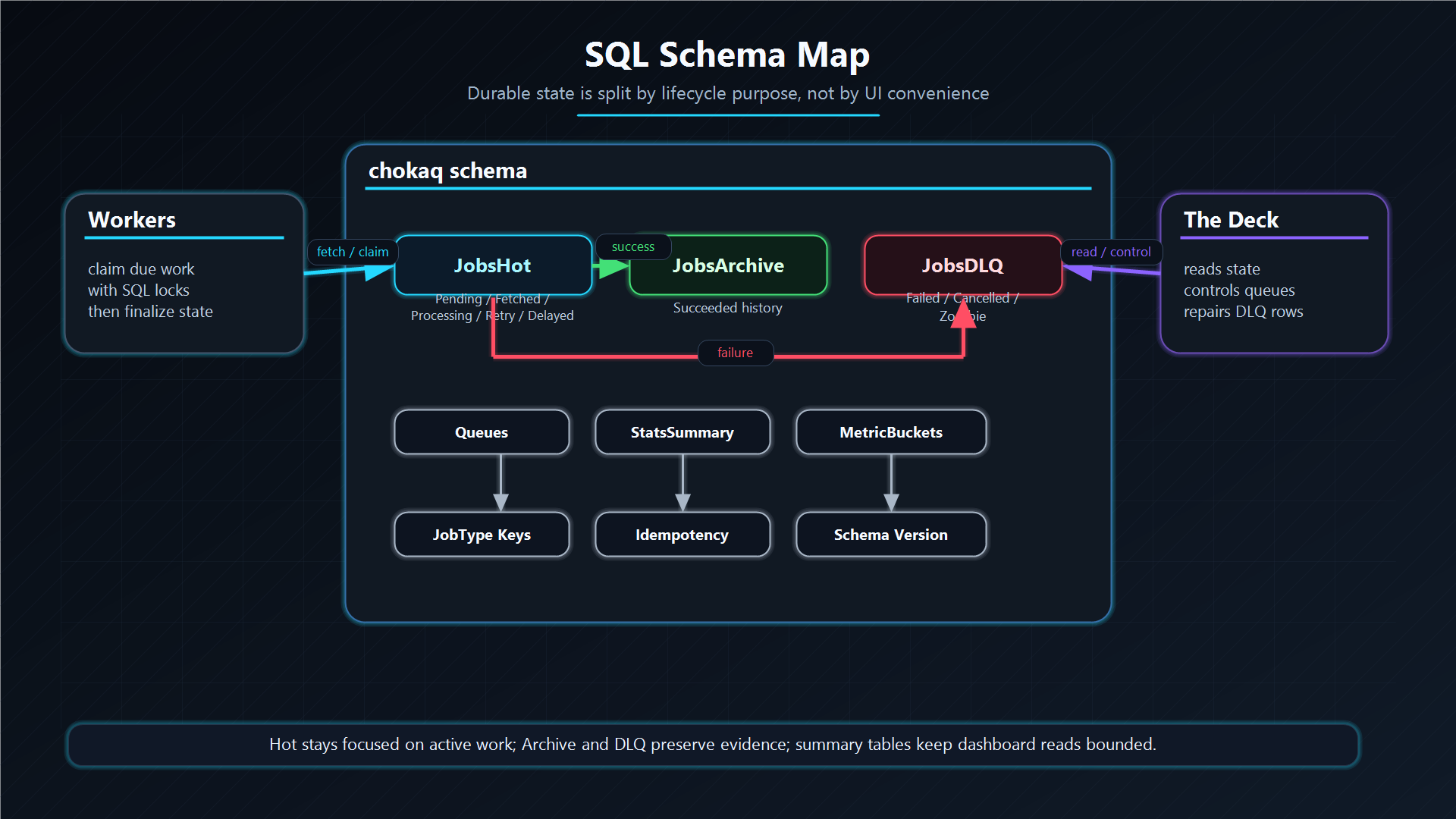
ChokaQ SQL Server storage is built around active work, immutable history, operator recovery, lifetime counters, rolling metrics, queue configuration, and schema migration metadata.
The default schema name is chokaq.
Tables
| Table | Purpose | Hot path? |
|---|---|---|
JobsHot | Active work: pending, fetched, processing, delayed retry. | Yes |
JobsArchive | Successful completed jobs. | No |
JobsDLQ | Failed, cancelled, zombie, or operator-held jobs. | No |
StatsSummary | Lifetime counters per queue. | No |
MetricBuckets | Recent throughput and failure-rate aggregates. | No |
Queues | Queue runtime configuration. | Yes, read by workers |
SchemaMigrations | Applied ChokaQ SQL schema versions. | Startup/ops |
JobsHot
JobsHot is the only table workers scan to find executable work. Keeping it small is the core performance decision behind the Three Pillars model.
Key columns:
| Column | Meaning |
|---|---|
Id | Stable job identifier. |
Queue | Queue partition and operational control boundary. |
Type | Persisted job type key. |
Payload | Serialized job payload. |
Tags | Optional operator/search metadata. |
IdempotencyKey | Optional active-work dedupe key. |
Priority | Higher values are fetched first. |
Status | Pending, fetched, or processing. |
AttemptCount | Number of executions that reached Processing. |
ScheduledAtUtc | Future eligibility time for delays and retries. |
WorkerId | Current worker owner after fetch. |
HeartbeatUtc | Processing liveness signal. |
Important indexes:
| Index | Supports |
|---|---|
IX_JobsHot_Fetch | Worker fetch ordering by queue, priority, schedule, creation time. |
IX_JobsHot_Idempotency | Unique active idempotency key. |
IX_JobsHot_QueueStats | Queue dashboard counts. |
IX_JobsHot_PendingLag | Queue lag health checks. |
IX_JobsHot_StatusCreated | Active job dashboard view. |
IX_JobsHot_FetchedRecovery | Abandoned fetched-job recovery. |
IX_JobsHot_ProcessingHeartbeat | Zombie detection. |
JobsArchive
JobsArchive stores succeeded jobs after a successful final transition. It is not part of the worker fetch path.
Indexes support recent history, queue-specific history, and tag search. Archive can grow independently from active work because workers do not scan it for new jobs.
JobsDLQ
JobsDLQ stores failed, cancelled, zombie, and operator-held jobs. It powers inspection, edit, resurrection, bulk requeue, bulk purge, and failure grouping.
Important indexes:
| Index | Supports |
|---|---|
IX_JobsDLQ_Date | Recent DLQ view. |
IX_JobsDLQ_Queue | Queue-scoped DLQ inspection. |
IX_JobsDLQ_Reason | Failure taxonomy filtering. |
IX_JobsDLQ_Type | Type-key failure triage. |
IX_JobsDLQ_CreatedAt | Age-based cleanup and investigation. |
StatsSummary
StatsSummary stores lifetime counters per queue:
- succeeded total;
- failed total;
- retried total;
- last activity timestamp.
It avoids recomputing lifetime counters by scanning Archive and DLQ.
MetricBuckets
MetricBuckets stores recent completion aggregates. ChokaQ updates buckets inside the same transaction that moves a job to Archive or DLQ.
This makes dashboard throughput cheap and stable:
- Archive answers investigation questions;
- DLQ answers recovery questions;
MetricBucketsanswers recent-rate questions.
Queues
Queues is the runtime control table. It stores:
- queue name;
- paused/active flags;
- per-queue zombie timeout;
- optional max worker budget;
- last update timestamp.
Workers read this table to avoid fetching paused queues and to enforce per-queue capacity.
SchemaMigrations
SchemaMigrations records applied ChokaQ schema versions. It turns first-start bootstrap into an auditable operation instead of relying only on idempotent CREATE TABLE IF MISSING logic.
Architecture Decision
Why this pattern?
The schema separates active work from historical evidence. That keeps worker queries small while preserving completed and failed jobs for operators.
Trade-offs
Moving between tables requires transaction integrity. The implementation must be careful to avoid copy-then-delete bugs. ChokaQ uses short SQL transactions and OUTPUT to make those moves atomic.
Alternatives considered
| Alternative | Benefit | Cost |
|---|---|---|
Single Jobs table with status column | Simple model. | Hot path degrades as history grows. |
| Broker-only queue | High throughput. | Less transparent operational state without extra storage. |
| Archive outside SQL | Smaller database. | Harder debugging and split-brain evidence. |
Additional Questions
Why not keep every job in one table?
Because active fetch queries would share indexes and storage with years of history, making the worker path sensitive to retention.
Why materialize MetricBuckets?
Because dashboard rate windows should not scan mutable history tables or change when an operator purges/requeues DLQ rows.
What is the main risk of this schema?
Cross-table moves must be atomic. That is why final transitions use database transactions and deleted-row capture.