
In-Memory Engine
Two Storage Modes, One Interface
ChokaQ's IJobStorage interface has two implementations:
| Implementation | Backing Store | Use Case |
|---|---|---|
InMemoryJobStorage | ConcurrentDictionary | Development, testing, high-throughput streaming |
SqlJobStorage | SQL Server tables | Production, persistence, multi-instance |
Both implement the same Three Pillars architecture — Hot, Archive, DLQ — just with different backing stores.
InMemoryJobStorage: How It Works
Three ConcurrentDictionary<string, T> instances mirror the SQL tables:
private readonly ConcurrentDictionary<string, JobHotEntity> _hotJobs = new();
private readonly ConcurrentDictionary<string, JobArchiveEntity> _archiveJobs = new();
private readonly ConcurrentDictionary<string, JobDLQEntity> _dlqJobs = new();
Capacity Protection
public InMemoryJobStorage(InMemoryStorageOptions options)
{
    _maxCapacity = options.MaxCapacity; // Default: 100,000
}

public ValueTask<string> EnqueueAsync(...)
{
    EnforceCapacity();
    _hotJobs[id] = job;
}
MaxCapacity is a soft retention cap for the in-process Three Pillars store. When the cap is reached, ChokaQ evicts old Archive rows first and old DLQ rows second. Hot rows are preserved because they are accepted work that the worker still needs to process.
Without a capacity policy, a runaway producer could fill the heap with old history. For production workloads where the backlog must survive process restarts, use SQL Server mode and let JobsHot be the durable pressure boundary.
Fetch: LINQ O(N) vs SQL Index
In-memory fetch uses LINQ instead of SQL:
public ValueTask<IEnumerable<JobHotEntity>> FetchNextBatchAsync(
    string workerId, int batchSize, string[]? allowedQueues, CancellationToken ct)
{
    var query = _hotJobs.Values
        .Where(j => j.Status == JobStatus.Pending)
        .Where(j => j.ScheduledAtUtc == null || j.ScheduledAtUtc <= DateTime.UtcNow);

    if (allowedQueues?.Length > 0)
        query = query.Where(j => allowedQueues.Contains(j.Queue));

    var batch = query
        .OrderByDescending(j => j.Priority)
        .ThenBy(j => j.ScheduledAtUtc ?? j.CreatedAtUtc)
        .Take(batchSize)
        .ToList();

    // Mark as Fetched (thread-safe via ConcurrentDictionary)
    foreach (var job in batch)
    {
        job.Status = JobStatus.Fetched;
        job.WorkerId = workerId;
    }

    return ValueTask.FromResult<IEnumerable<JobHotEntity>>(batch);
}
⚠️ O(N) Complexity
LINQ scans all jobs in the dictionary. For development with <10,000 jobs this is fine. For production loads, use SqlJobStorage where the filtered index provides O(log N) lookups.
The Prefetch Buffer: BoundedChannel
Between the fetcher and processor sits a Channel<JobHotEntity>:
// SqlJobWorker.cs
private readonly Channel<JobHotEntity> _channel =
    Channel.CreateBounded<JobHotEntity>(new BoundedChannelOptions(100)
    {
        FullMode = BoundedChannelFullMode.Wait,
        SingleReader = false,
        SingleWriter = true
    });
Why a Bounded Channel?
| Property | Value | Purpose |
|---|---|---|
Capacity | 100 | Maximum jobs buffered in memory |
FullMode | Wait | Fetcher blocks when buffer is full — backpressure |
SingleWriter | true | Only the fetcher loop writes — allows internal optimization |
SingleReader | false | Multiple processor tasks read concurrently |
The Producer-Consumer Flow
Why this design prevents memory issues:
- Fetcher grabs a batch (e.g., 50 jobs) from SQL
- Pushes them into the channel one by one
- If channel is full (100 jobs buffered),
WriteAsyncblocks - Fetcher stops polling SQL until processors drain the buffer
- No unbounded memory growth — maximum 100 jobs in RAM at any time
Backpressure in Action
Scenario: Processing is slow (10 jobs/sec), but fetcher gets 50 jobs/batch

t=0s:   Channel: [                    ] (0/100) — Fetcher gets 50, pushes all
t=0s:   Channel: [████████████████████] (50/100) — Processing starts
t=5s:   Channel: [████████████████    ] (40/100) — 10 processed, fetcher gets 50 more
t=5s:   Channel: [████████████████████████████] (90/100)
t=10s:  Channel: [██████████████████████████  ] (80/100) — 10 more processed
t=10s:  Fetcher gets 50, pushes 20 then BLOCKS ← backpressure kicks in
t=15s:  10 more processed, fetcher unblocks, pushes remaining 30
The system self-regulates. The SQL polling rate automatically adapts to processing capacity.
InMemoryQueue: Bounded Producer Channel
For the in-memory mode, InMemoryQueue uses a bounded channel of job objects. This channel is both the worker notification mechanism and the producer-side backpressure boundary:
public class InMemoryQueue : IChokaQQueue
{
    private readonly Channel<IChokaQJob> _queue =
        Channel.CreateBounded<IChokaQJob>(new BoundedChannelOptions(100_000)
        {
            FullMode = BoundedChannelFullMode.Wait,
            SingleReader = false,
            SingleWriter = false
        });

    public async Task EnqueueAsync<TJob>(TJob job, ...)
    {
        var id = await _storage.EnqueueAsync(...);
        await _queue.Writer.WriteAsync(job, ct);
    }
}
The JobWorker reads from this channel instead of polling:
// No polling needed; the channel is the notification mechanism.
while (await _queue.Reader.WaitToReadAsync(ct))
{
    while (_queue.Reader.TryRead(out var job))
    {
        var storageJob = await _storage.GetJobAsync(job.Id, ct);
        if (storageJob != null)
            await _processor.ProcessJobAsync(...);
    }
}
This is event-driven: zero CPU usage when idle, instant processing when a job arrives, and bounded producer memory when a burst exceeds worker throughput.
Memory Safety Summary
| Protection | Mechanism | Limit |
|---|---|---|
| In-process history | InMemory.MaxCapacity evicts old Archive/DLQ rows | 100,000 default |
| Producer channel | BoundedChannel<IChokaQJob> with Wait mode | 100,000 jobs |
| Prefetch buffer | BoundedChannel with Wait mode | 100 jobs |
| Processing concurrency | DynamicConcurrencyLimiter | Configurable |
| Archive/DLQ growth | Evicted before Hot rows when capacity is reached | Soft cap |
Architecture Insight
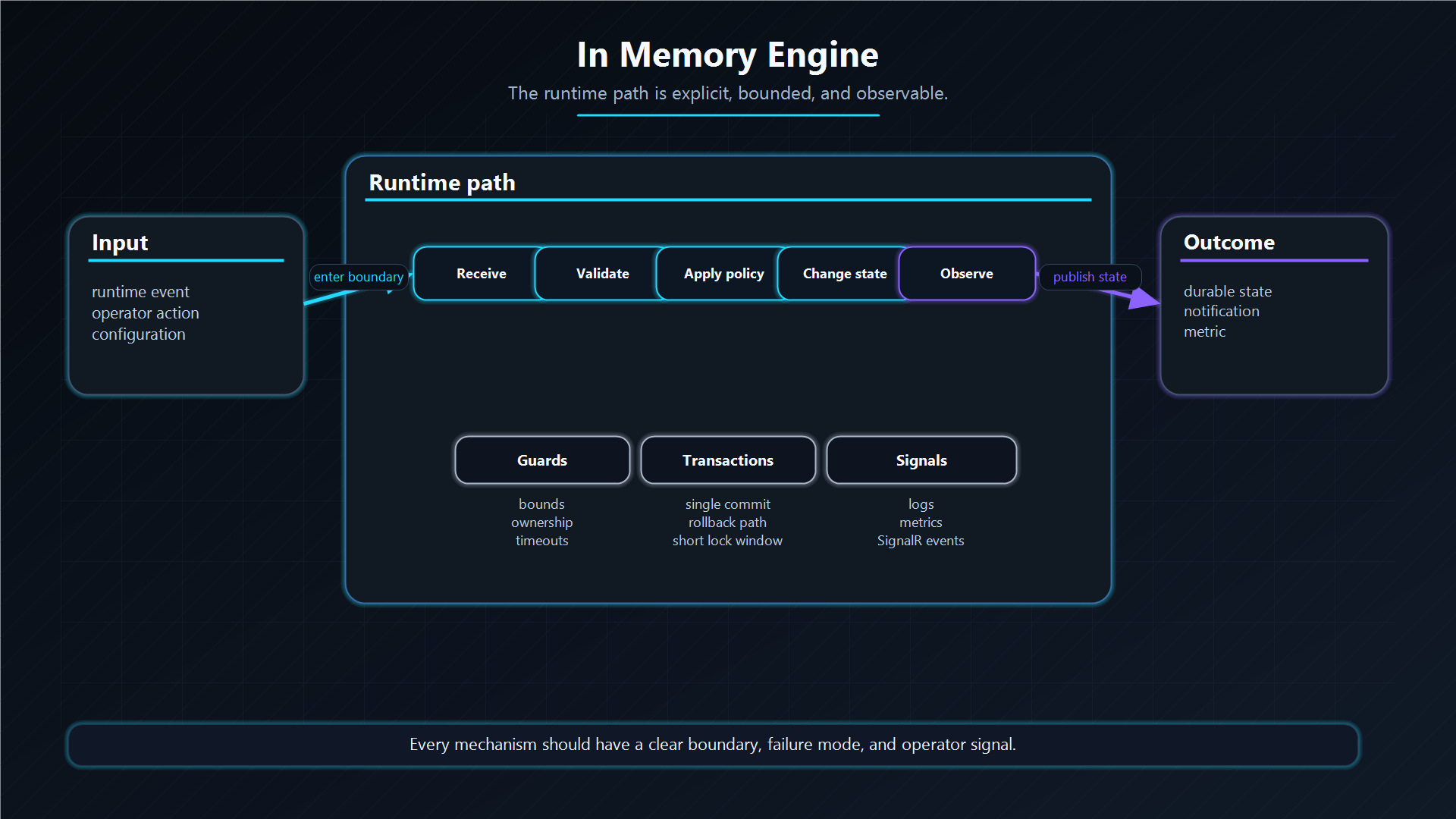
In-memory mode protects the process through layered pressure controls: InMemory.MaxCapacity limits retained history, the bounded producer channel slows callers when workers fall behind, and DynamicConcurrencyLimiter caps active execution. SQL Server mode moves the backlog out of process and uses the database as the durable pressure boundary.
Architecture Decision
The in-memory engine exists to make local development, tests, and volatile process-owned workloads fast without changing the public queue API. It mirrors the SQL model closely enough that handlers, middleware, dispatch, retries, and dashboard concepts remain understandable across both modes.
It is not positioned as a production durability story. ConcurrentDictionary and bounded channels are excellent in-process tools, but they cannot coordinate multiple hosts, survive a process crash, or provide database-level audit history. That is why the documentation treats SQL Server mode as the production default and in-memory mode as a deliberate local or ephemeral choice.
The important engineering boundary is that in-memory mode still has pressure limits. It does not use "demo mode" as an excuse for unbounded heap growth.
Additional Questions
Why keep an in-memory provider at all if SQL Server is the production path?
Because a storage abstraction is easier to trust when it can run fast tests and samples without infrastructure. The in-memory provider shortens feedback loops while preserving the same handler-facing contract.
What breaks if someone uses in-memory mode for critical production work?
Accepted jobs disappear on process loss, queue limits are process-local, and history cannot be shared across instances. That violates the durability and coordination guarantees expected from production background processing.
Why preserve Hot rows during capacity eviction?
Hot rows represent accepted unfinished work. Evicting Archive or DLQ history is less harmful than discarding work that still needs execution.
Next: Read the Backpressure Policy or explore The Deck Dashboard.