
Dynamic Concurrency Limiter (Lock-Free)
The Problem: Static Concurrency Limits
Standard SemaphoreSlim is initialized with a fixed capacity. Changing from 10 to 20 workers usually requires restarting the application or dealing with complex permit tracking and background cancellation tasks.
The Solution: Logical Concurrency + Coalescing Channel
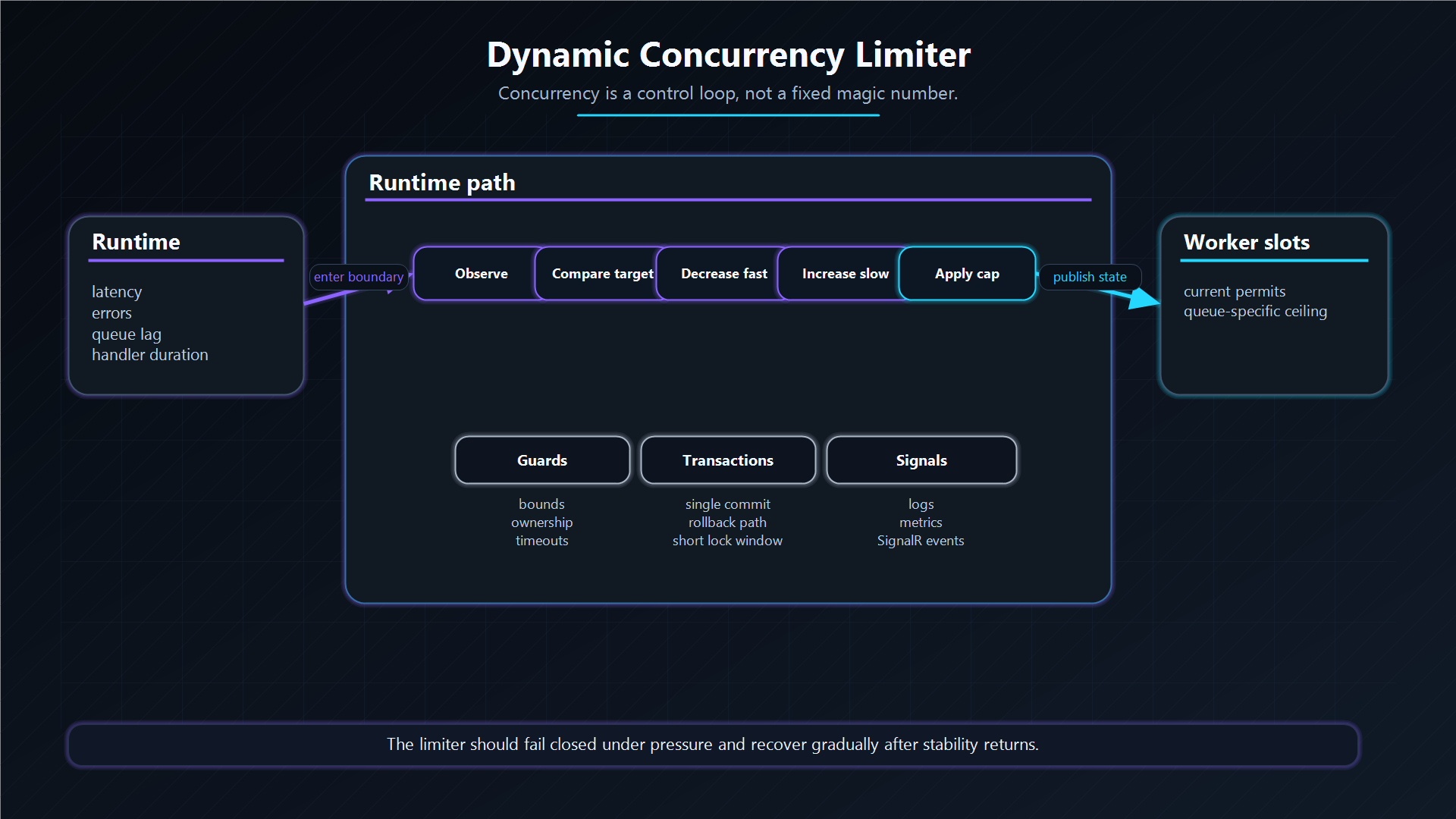
ChokaQ implements a completely lock-free, state-driven DynamicConcurrencyLimiter that drops the physical concept of "permits" entirely.
Instead of managing SemaphoreSlim slots, it uses two integers (_activeWorkers, _targetCapacity) and a highly optimized Channel<byte>.
1. Lock-Free Fast Path
When a worker tries to acquire a slot, it doesn't wait on a lock. It uses an atomic CompareExchange (CAS) operation:
int current = Volatile.Read(ref _activeWorkers);
int target = Volatile.Read(ref _targetCapacity);

if (current < target)
{
    // Try to atomically claim the slot
    if (Interlocked.CompareExchange(ref _activeWorkers, current + 1, current) == current)
    {
        // Slot acquired!
        return;
    }
}
This makes the "hot path" (when the system is under load but has capacity) nearly instantaneous, with zero allocations and zero context switches.
2. The Coalescing Signal
If the capacity is full, the worker drops into the "Slow Path" and awaits a signal:
private readonly Channel<byte> _signal = Channel.CreateBounded<byte>(
    new BoundedChannelOptions(1)
    {
        FullMode = BoundedChannelFullMode.DropOldest
    });

// ... inside Slow Path:
await _signal.Reader.ReadAsync(ct);
By configuring the Channel with a capacity of 1 and DropOldest, it acts as an asynchronous edge-triggered wakeup. It guarantees that signals never accumulate, preventing runaway CPU loops, while ensuring that sleepers are woken up when state changes.
3. Relay Wakeup (Chain Propagation)
When capacity is increased from 10 to 100, we don't want to wake 90 sleeping threads simultaneously (the "Thundering Herd" problem).
Instead, ChokaQ uses a Relay Wakeup pattern. When a worker successfully acquires a slot, it checks if there is still more capacity available. If yes, it passes the baton by waking exactly one more waiter:
// Inside successful Fast Path:
int latestTarget = Volatile.Read(ref _targetCapacity);

if (current + 1 < latestTarget)
{
    _signal.Writer.TryWrite(1); // Wake exactly one more waiter
}
This creates a smooth, chain-reaction scale-up that gracefully ramps up concurrency without slamming the thread pool.
4. Zero-Friction Scaling
Because the implementation relies purely on evaluating _activeWorkers < _targetCapacity inside a while(true) loop, dynamically changing the limit is as simple as updating a variable and sending a single ping:
public void SetCapacity(int newCapacity)
{
    Volatile.Write(ref _targetCapacity, newCapacity);

    // Kickstart the wakeup chain
    _signal.Writer.TryWrite(1);
}
If you scale down (e.g., 20 → 10), _targetCapacity is instantly updated. Existing workers finish their current jobs and call Release(), which decrements _activeWorkers. No new workers will be allowed to pass the Fast Path until _activeWorkers naturally drains below 10.
No cancellation tokens, no background burner tasks, no permit leaks. Just pure, state-driven mathematics.
Misuse And Shutdown Contract
Release() must match a successful WaitAsync(). A double release throws instead of silently repairing the counter, because hidden accounting bugs can make worker capacity telemetry lie.
Disposal wakes waiting callers and future WaitAsync() calls fail with ObjectDisposedException. Releasing a slot that was acquired before disposal is allowed during shutdown, so worker cleanup can finish normally.
Fairness
The limiter does not promise FIFO waiter fairness. It uses competitive scheduling for throughput and low overhead, which is appropriate for background job workers. Do not use this primitive as a user-facing rate limiter without a separate fairness review.
Architecture Decision
The limiter is optimized for background worker throughput, not user-facing fairness. ChokaQ needs a primitive that can change target capacity at runtime when The Deck changes queue controls or when the host adapts worker pressure. A fixed SemaphoreSlim is simple, but it is awkward to resize safely without permit drift, leaked releases, or restarting the worker manager.
The chosen design keeps the authoritative state in counters: _activeWorkers tells how many executions are currently inside the critical section, and _targetCapacity tells how many are allowed. Scaling down is therefore passive and safe: running jobs finish naturally, and new jobs wait until active count drops below the new target.
The main trade-off is fairness. Waiters compete when capacity opens instead of being served by a strict FIFO queue. For background jobs this is acceptable because work ordering is already governed by SQL priority, schedule time, queue bulkheads, and retry policy.
Additional Questions
Why not just recreate a SemaphoreSlim when capacity changes?
Because existing waiters and acquired permits belong to the old object. Swapping semaphores creates edge cases around releases, cancellation, and waiters waking on a primitive that is no longer authoritative.
How does the limiter avoid thundering-herd wakeups?
It uses a bounded one-item signal channel and relay wakeup. A capacity change emits one signal; each successful acquirer wakes another waiter only if more capacity remains.
What invariant proves the design is safe?
No caller can enter unless it successfully increments _activeWorkers while the observed active count is below _targetCapacity. Release() decrements the same counter and double release is treated as a bug.
Next: In-Memory Engine — BoundedChannels and backpressure.