
Failure Taxonomy
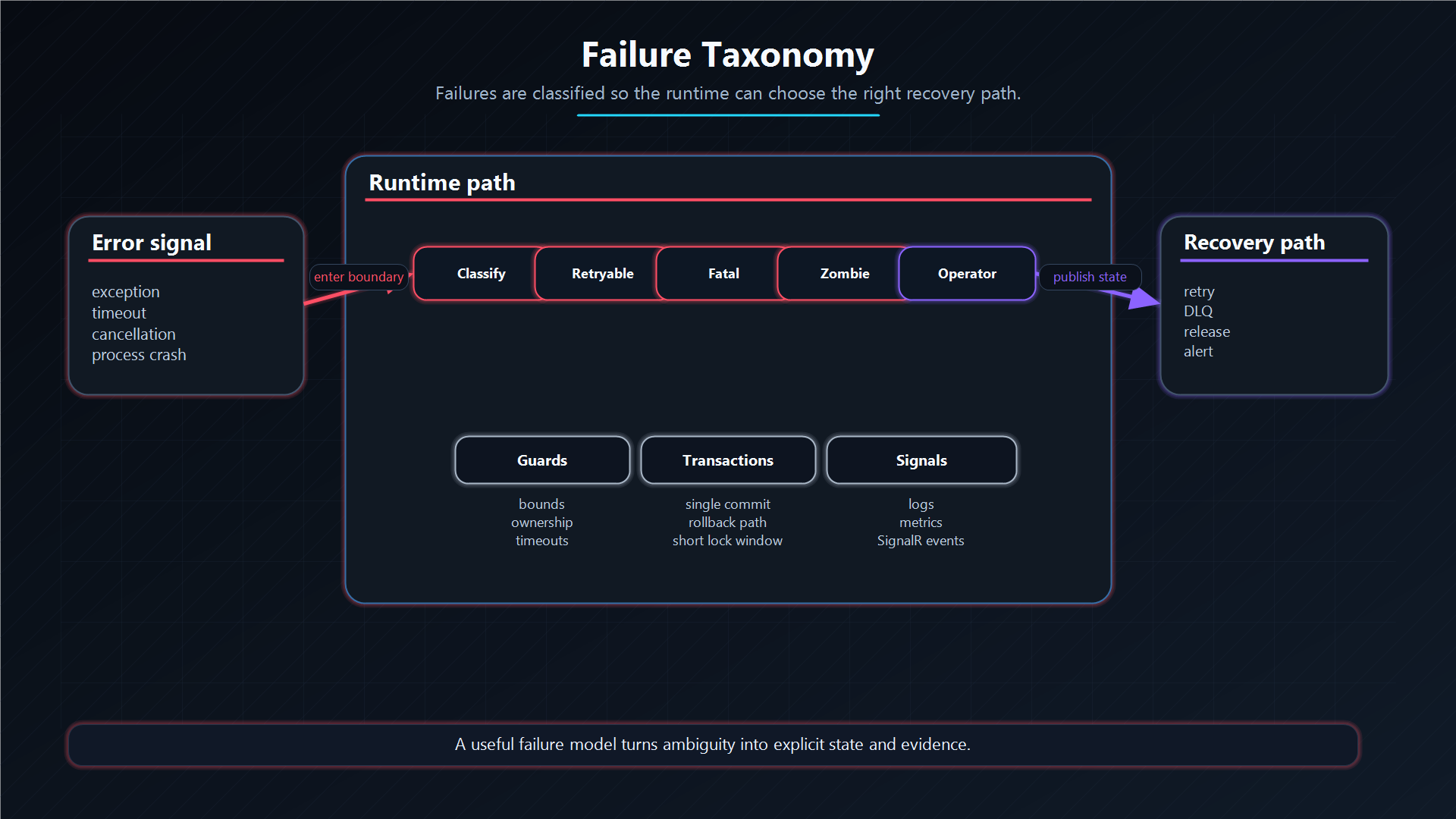
Failure taxonomy turns raw exceptions into operational meaning. ChokaQ stores a FailureReason when a job lands in DLQ so operators can triage by category instead of reading every stack trace first.
Why Taxonomy Matters
Two failed jobs can require very different actions:
- a transient HTTP timeout may be safe to retry;
- a malformed payload should be fixed before retry;
- a zombie job may have already sent an email or charged a card;
- an admin-cancelled job may be intentionally stopped.
The taxonomy preserves that distinction in data.
Common Reasons
| Reason | Meaning | Typical response |
|---|---|---|
MaxRetriesExceeded | Retry budget exhausted. | Fix cause, then sample resurrection. |
FatalError | Classified as non-transient. | Fix code or payload first. |
Timeout | Handler exceeded timeout. | Tune handler or timeout; inspect side effects. |
Cancelled | Operator/runtime cancellation. | Confirm intent. |
Zombie | Heartbeat expired during processing. | Inspect side effects before retry. |
CircuitBreakerOpen | Execution blocked by open circuit. | Fix downstream before forcing recovery. |
Throttled | Downstream overload/rate limit. | Respect retry-after and reduce pressure. |
Transient | Retryable family eventually exhausted. | Check downstream instability. |
HeartbeatFailure | Heartbeat write failure crossed policy. | Check SQL/storage pressure. |
RetryLifetimeExpired | Job became too old to retry. | Treat as stale work. |
Smart Worker Relationship
Smart Worker classification decides whether a failure should retry or fast-fail to DLQ. Failure taxonomy is the persisted operator-facing result.
Architecture Decision
Why this pattern?
Operators need routing metadata. Raw exception text is useful for debugging, but safe bulk actions, dashboards, and incident triage also need stable failure categories.
Trade-offs
Classification can be wrong if application exceptions are too generic. Apps should throw meaningful fatal/throttled/transient signals where possible.
Alternatives considered
| Alternative | Benefit | Cost |
|---|---|---|
| Store stack traces only | Simple. | Poor filtering and unsafe bulk decisions. |
| Use exception type only | Automatic. | Loses operational categories like zombie/cancelled. |
| App-owned categories only | Flexible. | No consistent runtime semantics. |
Additional Questions
Why persist failure reason separately from error details?
Because operators need stable categories for filtering, dashboards, and actions.
Which failures need inspection before retry?
Zombie, fatal payload/code errors, cancelled jobs, and stale jobs beyond lifetime policy.
How does this help The Deck?
The Deck can group, filter, badge, and bulk-preview based on reason instead of free-form exception text.