
SQL Concurrency: UPDLOCK + READPAST
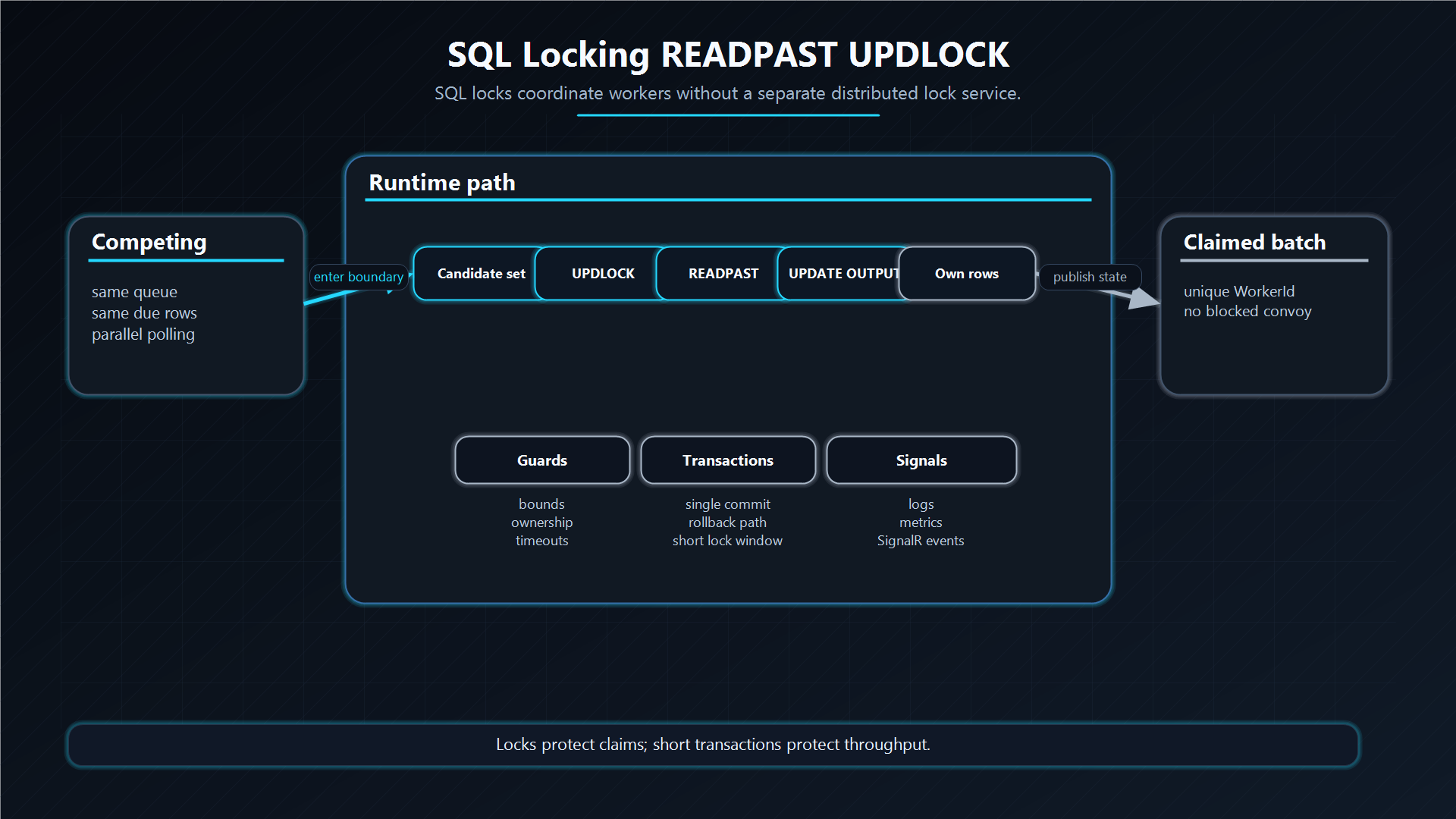
The Challenge: Competing Consumers
Multiple worker instances (or threads) need to grab jobs from the same table simultaneously without:
- Two workers grabbing the same job (duplicate processing)
- Workers blocking each other (deadlocks, waits)
- Lost updates when concurrent UPDATEs collide
This is the classic competing consumers problem in distributed systems.
The Solution: A Single SQL Query
-- From: Queries.cs — FetchNextBatch

WITH ActiveCounts AS (
    SELECT [Queue], COUNT(1) AS CurrentActive
    FROM [{SCHEMA}].[JobsHot]
    WHERE [Status] IN (1, 2)
    GROUP BY [Queue]
),
Candidates AS (
    SELECT
        h.[Id],
        h.[Priority],
        ISNULL(h.[ScheduledAtUtc], h.[CreatedAtUtc]) AS SortUtc,
        q.[MaxWorkers],
        ISNULL(ac.CurrentActive, 0) AS CurrentActive,
        ROW_NUMBER() OVER (
            PARTITION BY h.[Queue]
            ORDER BY h.[Priority] DESC,
                     ISNULL(h.[ScheduledAtUtc], h.[CreatedAtUtc]) ASC
        ) AS QueueRank
    FROM [{SCHEMA}].[JobsHot] h WITH (UPDLOCK, READPAST)
    LEFT JOIN [{SCHEMA}].[Queues] q ON h.[Queue] = q.[Name]
    LEFT JOIN ActiveCounts ac ON h.[Queue] = ac.[Queue]
    WHERE h.[Status] = 0
      AND (q.[IsPaused] IS NULL OR q.[IsPaused] = 0)
      AND (q.[IsActive] IS NULL OR q.[IsActive] = 1)
      AND (h.[ScheduledAtUtc] IS NULL OR h.[ScheduledAtUtc] <= SYSUTCDATETIME())
),
Picked AS (
    SELECT TOP (@Limit) [Id]
    FROM Candidates
    WHERE [MaxWorkers] IS NULL
       OR ([CurrentActive] + [QueueRank]) <= [MaxWorkers]
    ORDER BY [Priority] DESC, [SortUtc] ASC
)
UPDATE h
SET h.[Status] = 1,                    -- Fetched
    h.[WorkerId] = @WorkerId,
    h.[LastUpdatedUtc] = SYSUTCDATETIME()
OUTPUT
    INSERTED.[Id], INSERTED.[Queue], INSERTED.[Type],
    INSERTED.[Payload], INSERTED.[Tags], INSERTED.[IdempotencyKey],
    INSERTED.[Priority], INSERTED.[Status], INSERTED.[AttemptCount],
    INSERTED.[WorkerId], INSERTED.[HeartbeatUtc],
    INSERTED.[ScheduledAtUtc], INSERTED.[CreatedAtUtc],
    INSERTED.[StartedAtUtc], INSERTED.[LastUpdatedUtc],
    INSERTED.[CreatedBy], INSERTED.[LastModifiedBy]
FROM [{SCHEMA}].[JobsHot] h WITH (UPDLOCK, READPAST)
INNER JOIN Picked p ON p.[Id] = h.[Id]
Let's break this apart piece by piece.
The Locking Hints Explained
UPDLOCK — Reserve Before Update
FROM [chokaq].[JobsHot] h WITH (UPDLOCK, ...)When SQL Server reads a row with UPDLOCK, it acquires an update lock (U-lock) on that row:
- Other readers (normal
SELECT) can still read the row ✅ - Other
UPDLOCKreaders skip the row or wait ❌ - No other transaction can update or delete the locked row ❌
The U-lock is held until the transaction completes — in our case, until the UPDATE SET Status = 1 finishes.
READPAST — Skip Locked Rows
FROM [chokaq].[JobsHot] h WITH (UPDLOCK, READPAST)Without READPAST, Worker B would block waiting for Worker A to release its locks. With READPAST:
Worker A: SELECT with UPDLOCK → grabs rows 1, 2, 3 (locks them)
Worker B: SELECT with UPDLOCK, READPAST → SKIPS 1,2,3 → grabs rows 4, 5, 6
Worker C: SELECT with UPDLOCK, READPAST → SKIPS 1-6 → grabs rows 7, 8, 9
The hot path avoids waiting on rows that another worker already locked. That is the operational reason for READPAST: workers keep making progress instead of forming a convoy behind the first locked row.
Committed ActiveCounts
WITH ActiveCounts AS (
    SELECT [Queue], COUNT(1) AS CurrentActive
    FROM [chokaq].[JobsHot]
    WHERE [Status] IN (1, 2)
    GROUP BY [Queue]
)
The CTE that counts active jobs per queue deliberately uses the default committed-read behavior. This count participates in the bulkhead decision, so dirty reads are not acceptable:
- A dirty low count could let a queue temporarily exceed
MaxWorkers. - A dirty high count could starve a queue based on work that later rolls back.
- Capacity decisions belong to the correctness path; only passive dashboard telemetry is allowed to use
NOLOCK.
This is still not a serializable global semaphore. The authoritative protection remains the single UPDATE ... OUTPUT fetch statement plus the worker-owned MarkAsProcessing gate, but reading committed active counts avoids avoidable decisions based on uncommitted data.
The UPDATE...OUTPUT Pattern
Instead of SELECT + UPDATE (two round-trips, race condition window), ChokaQ uses a single UPDATE...OUTPUT:
UPDATE TOP (@Limit) h
SET h.[Status] = 1,
    h.[WorkerId] = @WorkerId,
    h.[LastUpdatedUtc] = SYSUTCDATETIME()
OUTPUT INSERTED.*                     -- Return the updated rows
FROM [chokaq].[JobsHot] h WITH (UPDLOCK, READPAST)
WHERE ...
Why this is superior to SELECT + UPDATE:
| Approach | Round-trips | Race Window | Locks |
|---|---|---|---|
SELECT then UPDATE | 2 | Gap between SELECT and UPDATE | Must hold lock across two operations |
UPDATE...OUTPUT | 1 | None — atomic | Lock acquired and released in one operation |
Walking Through The Candidate Filters
WHERE h.[Status] = 0                                   -- Only Pending
  AND (q.[IsPaused] IS NULL OR q.[IsPaused] = 0)       -- Not paused
  AND (q.[IsActive] IS NULL OR q.[IsActive] = 1)       -- Not deactivated
  AND (h.[ScheduledAtUtc] IS NULL                      -- Not scheduled for future
       OR h.[ScheduledAtUtc] <= SYSUTCDATETIME())

-- Bulkhead check happens after candidates are ranked per queue:
WHERE [MaxWorkers] IS NULL
OR ([CurrentActive] + [QueueRank]) <= [MaxWorkers]| # | Filter | Purpose |
|---|---|---|
| 1 | Status = 0 | Only grab Pending jobs, not Fetched or Processing. |
| 2 | IsPaused = 0 | Respect queue pause. |
| 3 | IsActive = 1 | Skip deactivated queues. |
| 4 | ScheduledAtUtc <= NOW | Only fetch jobs whose delay has expired. |
| 5 | CurrentActive + QueueRank <= MaxWorkers | Enforce remaining per-queue capacity inside the batch, so one fetch cannot overshoot a queue limit. |
The ORDER BY: Priority + Schedule
ORDER BY h.[Priority] DESC,
ISNULL(h.[ScheduledAtUtc], h.[CreatedAtUtc]) ASC- Priority DESC — Higher number is selected before lower priority work when both are eligible.
- ScheduledAt ASC — Within the same priority, older eligible work is selected before newer work.
The ISNULL handles the common case where ScheduledAtUtc is NULL (immediate execution) and falls back to creation time for the selection order.
This is a fetch ordering policy, not a strict end-to-end FIFO guarantee. Multiple workers, per-queue limits, retries, pause/resume, cancellation, and operator actions can change completion order.
Fairness Policy
SQL fetch provides best-effort scheduling, not strict global fairness. Each fetch claim orders eligible rows by priority and due time, and per-queue MaxWorkers keeps one queue from consuming more than its configured capacity. Under heavy concurrency, READPAST may skip rows that another worker has locked, so a later eligible row can be claimed first.
That trade-off is intentional: ChokaQ prefers forward progress and duplicate claim prevention over making workers wait behind locked rows. If you need stronger business fairness, use separate queues, explicit priorities, and MaxWorkers caps to encode that policy.
Concurrency Proof
Scenario: 3 workers, batch size 2, 9 pending jobs
Database state BEFORE fetch:

| Row 1 | Row 2 | Row 3 |
|---|---|---|
| Job-1 (P) | Job-2 (P) | Job-3 (P) |
| Job-4 (P) | Job-5 (P) | Job-6 (P) |
| Job-7 (P) | Job-8 (P) | Job-9 (P) |


Worker A executes: UPDATE TOP(2) ... WITH (UPDLOCK, READPAST)
  → Locks Job-1, Job-2
  → Sets Status=1, WorkerId="worker-A"
  → OUTPUT returns Job-1, Job-2

Worker B executes: UPDATE TOP(2) ... WITH (UPDLOCK, READPAST)
  → READPAST skips Job-1, Job-2 (locked by A)
  → Locks Job-3, Job-4
  → Sets Status=1, WorkerId="worker-B"
  → OUTPUT returns Job-3, Job-4

Worker C executes: UPDATE TOP(2) ... WITH (UPDLOCK, READPAST)
  → READPAST skips Job-1–4 (locked by A, B)
  → Locks Job-5, Job-6
  → OUTPUT returns Job-5, Job-6

Result: each worker gets a unique pair from this fetch path.
💡 Architecture Insight
The UPDLOCK + READPAST combination gives ChokaQ a database-level claim primitive. It prevents duplicate fetch claims without a distributed lock service. Processing still uses worker ownership and lease checks because real systems must also handle shutdown, stale buffers, zombie rescue, and operator actions after the initial fetch.
Next: See how Expression Trees eliminate reflection overhead for handler invocation.
Architecture Decision
Why this pattern?
SQL is the coordination boundary. UPDLOCK reserves candidate rows before the update and READPAST lets other workers skip locked rows instead of blocking.
Trade-offs
READPAST can skip locked rows temporarily, so strict FIFO is not guaranteed under contention. ChokaQ prefers progress and concurrency over perfect ordering.
Alternatives considered
| Alternative | Benefit | Cost |
|---|---|---|
| Distributed lock service | Explicit locks. | Extra infrastructure and failure modes. |
SELECT then UPDATE | Simple. | Races under concurrent workers. |
| Broker visibility timeout | Mature primitive. | Different operational model. |
Additional Questions
Why use UPDATE ... OUTPUT?
To claim and return the exact rows in one database operation.
What is the downside of READPAST?
It trades strict ordering for throughput by skipping locked rows.
Where is duplicate execution still possible?
After handler side effects but before finalization; handler idempotency handles that boundary.