
Transaction Integrity
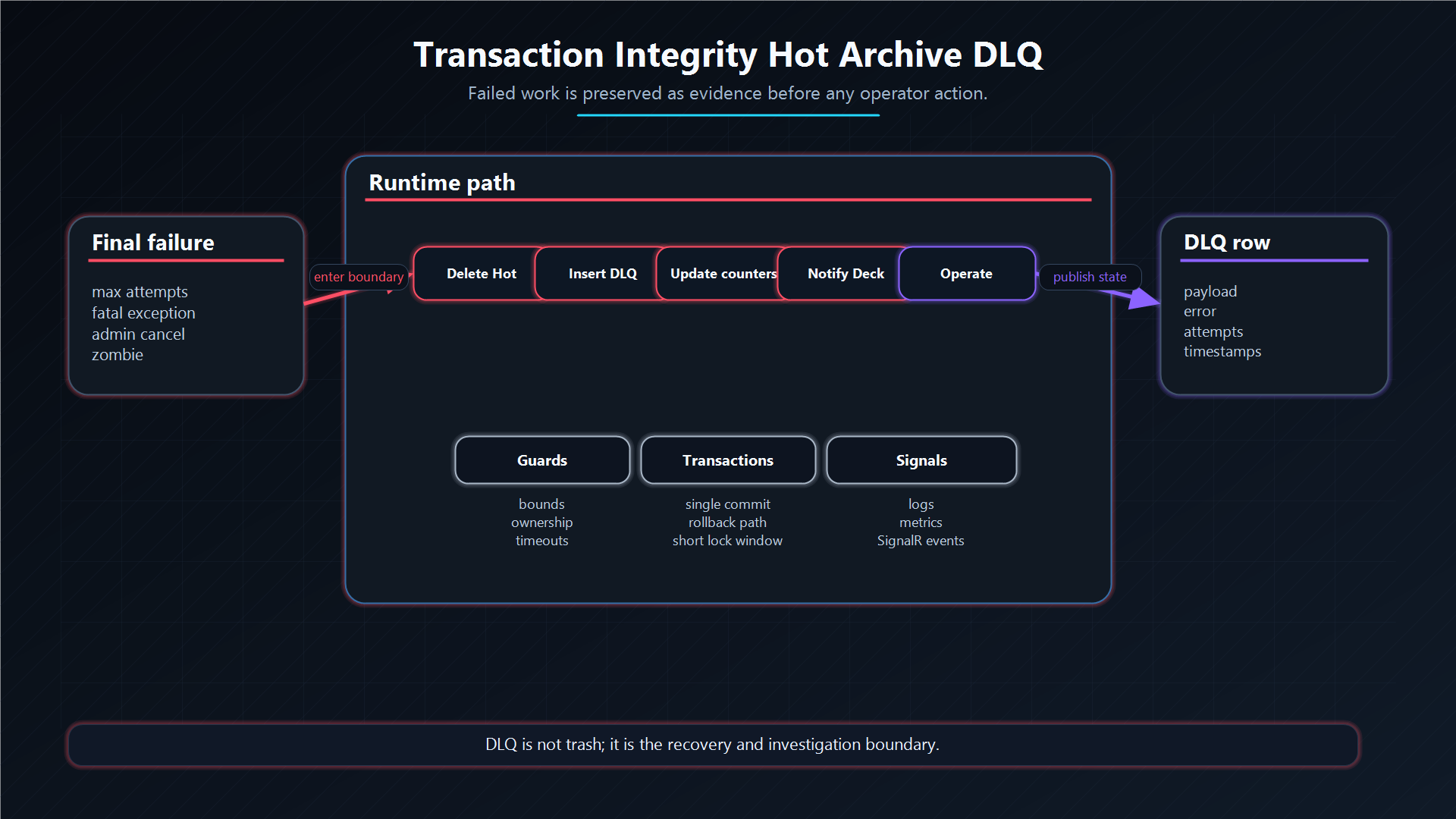
Transaction integrity is the line between "a job moved" and "a job was copied somewhere and maybe deleted later." ChokaQ treats final lifecycle transitions as database integrity boundaries.
The important moves are:
JobsHottoJobsArchiveafter success;JobsHottoJobsDLQafter terminal failure, cancellation, or zombie rescue;JobsDLQback toJobsHotduring resurrection;- final-state counter and metric bucket updates that must match the move.
Where It Lives
The SQL templates live in ChokaQ.Storage.SqlServer.DataEngine.Queries. The storage API executes them through SqlJobStorage. Worker-owned finalization is routed through JobProcessor and JobStateManager.
The Move Pattern
The core pattern is:
SET XACT_ABORT ON.- Begin a short SQL transaction.
- Delete the source row.
- Capture the exact deleted row with
OUTPUT ... INTO @Moved. - Insert the captured row into the destination table.
- Update
StatsSummary. - Update
MetricBucketswhen the move represents a completion outcome. - Commit.
- Roll back on error.
That means the job is never half-moved. If the destination insert or counter update fails, SQL Server rolls the source row back.
Why Delete First?
For Archive and DLQ moves, deleting from JobsHot first captures the authoritative row. The row captured in @Moved is exactly the row that was removed. This matters when stale workers, zombie rescue, cancellation, or admin actions race each other.
For resurrection, deleting from JobsDLQ first prevents two admin tabs from inserting the same job back into JobsHot.
Ownership Guards
Worker-owned transitions include WorkerId predicates where applicable. A stale worker should not be able to finalize a job after another recovery path has already reclaimed or moved it.
Zero affected rows are not treated as successful movement. They mean the runtime no longer owns that row.
What Transactions Do Not Solve
Database transactions protect ChokaQ state. They do not make external side effects exactly-once.
If a handler charges a card and the process crashes before Archive, ChokaQ may run the job again after recovery. The fix is business idempotency at the handler or downstream provider boundary.
Architecture Decision
Why this pattern?
The database is already the durable source of truth. Using short transactions for lifecycle moves keeps correctness local to the storage provider and avoids introducing a second coordination system.
Trade-offs
Transactions add lock duration and require careful query design. ChokaQ keeps transactions short and limited to state movement, counters, and metric bucket writes. User handler code never runs inside these SQL transactions.
Alternatives considered
| Alternative | Benefit | Cost |
|---|---|---|
| Copy then delete in application code | Simple to write. | Can duplicate or lose rows on crash. |
| Single-table status update | Fewer cross-table moves. | Hot path competes with historical data. |
| Distributed transaction with external side effect | Stronger theoretical coupling. | Operationally fragile and rarely supported by modern services. |
When not to use this approach
For extremely high-throughput ephemeral events where audit/history is unimportant, a broker append log may be a better fit. ChokaQ optimizes for durable business work, visibility, and repairability.
Additional Questions
Which operations must be atomic?
Final state transitions: Hot to Archive, Hot to DLQ, DLQ to Hot, and their associated counters/metric buckets.
What happens after handler success but before Archive if the process crashes?
The job may be recovered and executed again. That is why ChokaQ documents at-least-once execution and requires idempotent side effects.
Why not put handler execution inside the SQL transaction?
Because external calls can be slow, block locks, time out, or never participate in the database transaction. The transaction should protect ChokaQ state, not wrap arbitrary business work.